


Local construction conditions are a key consideration for new and established businesses seeking to build, upgrade or scale their facilities. A locale’s construction environment directly shapes project timelines and building costs. When construction markets are healthy, firms can expand more efficiently and capitalize on new opportunities without delay.
A helpful way to assess local market conditions is to examine the relative shares of GDP and employment in each sector. The ratio of GDP to employment captures output per worker, a metric of productivity. We use this method to produce our local construction productivity measure: by dividing a region’s construction GDP share by its construction employment share. This evaluation shows how efficiently local construction markets translate labor into economic output.
This report assesses construction productivity across the American Growth Project’s 50 largest US Extended Metropolitan Areas, highlighting regional patterns. Several Southern and inland cities, including Las Vegas and Atlanta (see Figure 1), rank among the most productive. Their strong performance reflects flexible regulatory environments, strong logistics networks, favorable weather conditions and rapid population growth, which together fuel construction. In contrast, heavily regulated, crowded coastal metros such as New York and Los Angeles typically exhibit lower output per construction worker. Understanding these rankings and underlying metrics can help businesses make better informed decisions about where to establish or expand their operations.
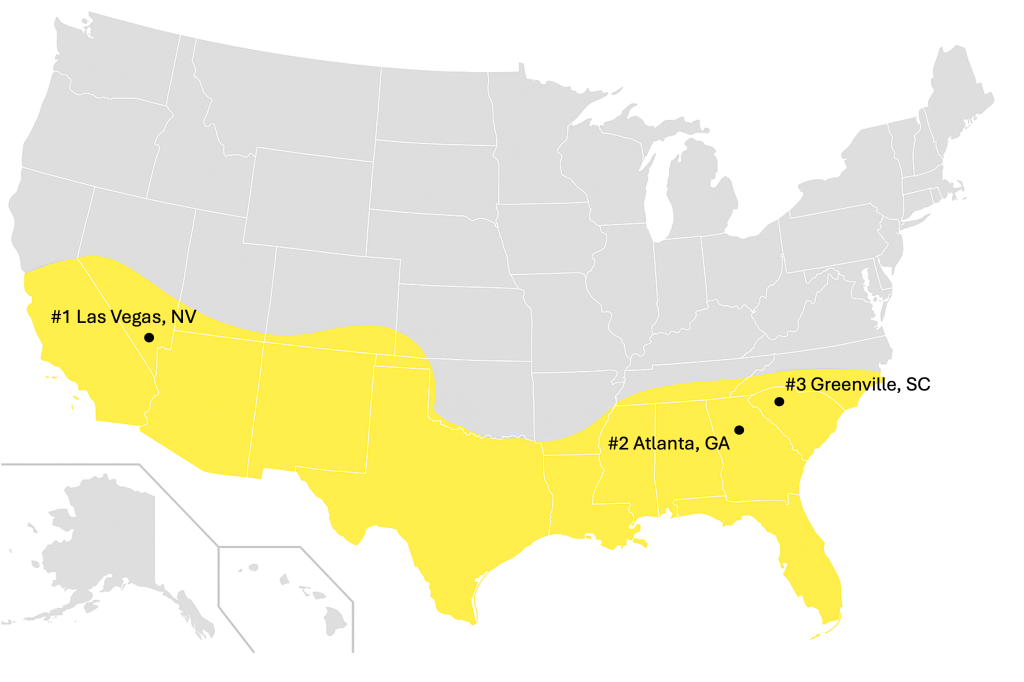
Key Components of Construction Productivity
Construction productivity is determined by two core components: construction GDP and construction employment. The share of GDP generated by construction reflects underlying demand for residential, commercial and industrial space — demand that is heavily influenced by population growth. Expanding populations drive major public infrastructure projects, such as airport upgrades and highway expansions, which raise the share of GDP linked to construction.
Local characteristics and national economic conditions also affect construction’s share of GDP. In warmer and/or drier regions, projects can continue without winter slowdowns, supporting steadier output. Logistics networks play a role, too; access to interstate corridors (e.g., I‑75/I‑85 corridor in Atlanta and the I‑15 corridor in Las Vegas and Salt Lake City) can reduce the cost of transporting construction materials. At the national level, macroeconomic conditions, including interest rates and the broader business cycle, shape both the supply of new construction and the demand for it, either accelerating or slowing activity.
Construction employment is influenced by many of the same forces. Population growth increases demand for housing, infrastructure, schools and commercial space, and it also expands the labor pool, improving firms’ ability to recruit workers with the requisite skills and experience to support higher productivity. Other factors strengthen the availability of construction labor: competitive wages, steady wage growth and robust training or apprenticeship programs help attract and retain workers. An area’s climate matters as well: Regions with favorable year round weather offer more stable employment opportunities and fewer seasonal disruptions.
Recent trade policy developments have also shaped construction employment. Tariffs on materials including steel and aluminum have raised input costs for some firms, leading to project delays that may soften hiring. This has occurred in many major West Coast cities, such as San Francisco and San Jose, Los Angeles, and Seattle, which rely heavily on steel and aluminum from Asia.
Along with the factors described above, regulatory flexibility and technological adoption influence construction productivity. Local regulatory frameworks, including zoning laws and permit approval timelines, determine how quickly projects can move from planning to execution. Meanwhile, firms that adopt modern construction technologies are better positioned to streamline workflows and improve overall job site efficiency.
Geographic Patterns in Construction Productivity
Table 1 shows the highest performing cities for construction GDP, employment and productivity. Construction productivity, as measured by GDP share divided by employment share, can be attributed to several key factors. Inland metros with more favorable year-round weather conditions, recent population growth and flexible zoning laws (e.g., Atlanta, Salt Lake City, Sacramento) often achieve higher levels of construction productivity. These Extended Metropolitan Areas benefit from warm and/or dry climates that facilitate a longer construction season, along with flat land that is suitable and available for construction. Highly productive EMAs, particularly those in the Sun Belt, have experienced an influx of newcomers in recent years, boosting demand for housing, infrastructure and commercial development.
Table 1: Highest Performing Cities For Construction GDP, Employment And Productivity
Flexible zoning regulations and supportive logistics networks also have a role in promoting construction productivity. Zoning environments in cities with high levels of construction productivity are typically more relaxed, which reduces construction barriers and delays (e.g., zoning amendments designed to expand housing supply in Grand Rapids). They also have strong logistics networks that support the inflow of construction materials (e.g., the I-5 corridor in Sacramento and Fresno).
Conversely, built-out coastal cities with slower population growth and stricter zoning laws exhibit lower productivity. These cities, which include New York, Miami, Seattle and to a lesser extent Los Angeles, face geographic restrictions that result in a lack of buildable land as well as restrictive land-use regulations. Miami, for example, has protected wetlands on which properties cannot be built, while New York and Los Angeles are home to some of the most exclusionary zoning laws in the country. Weather plays a role, too. Northern metros like Detroit and Boston face construction barriers during winter months, while hurricane prone metros like Miami and New Orleans contend with storm related delays in late summer and early fall.
Implications for Business Expansion
Understanding geographic differences in construction productivity can help firms make better-informed decisions about where and how to build. Using the rankings and productivity metrics outlined in this report, businesses can identify EMAs where construction activity is most efficient. High productivity EMAs, many of which are based in the Southeast and Southwest, require less labor to build office spaces, warehouses and other types of facilities than do their low-productivity counterparts.
| High Productivity EMAs | Low Productivity EMAs |
|---|---|
| Inland | Coastal |
| Sun Belt or Sun Belt-adjacent | Located in both North and South |
| Dry and/or warm year-round weather | Prone to winter storms or hurricanes |
| Available, flat land | Limited land for expansion |
| Rapid population growth | Slower population growth |
| Flexible zoning | Strict zoning |
For businesses in EMAs with relatively low construction productivity, targeted improvements can help address underlying challenges in the construction sector. Artificial Intelligence and other technology adoption, such as workflow automation tools and advanced project-management systems, can boost efficiency even in low-productivity markets. Implementing flexible zoning laws would also help to streamline construction projects and boost productivity. By understanding both the strengths and limitations of local construction environments, businesses can better allocate resources and develop long term expansion strategies.