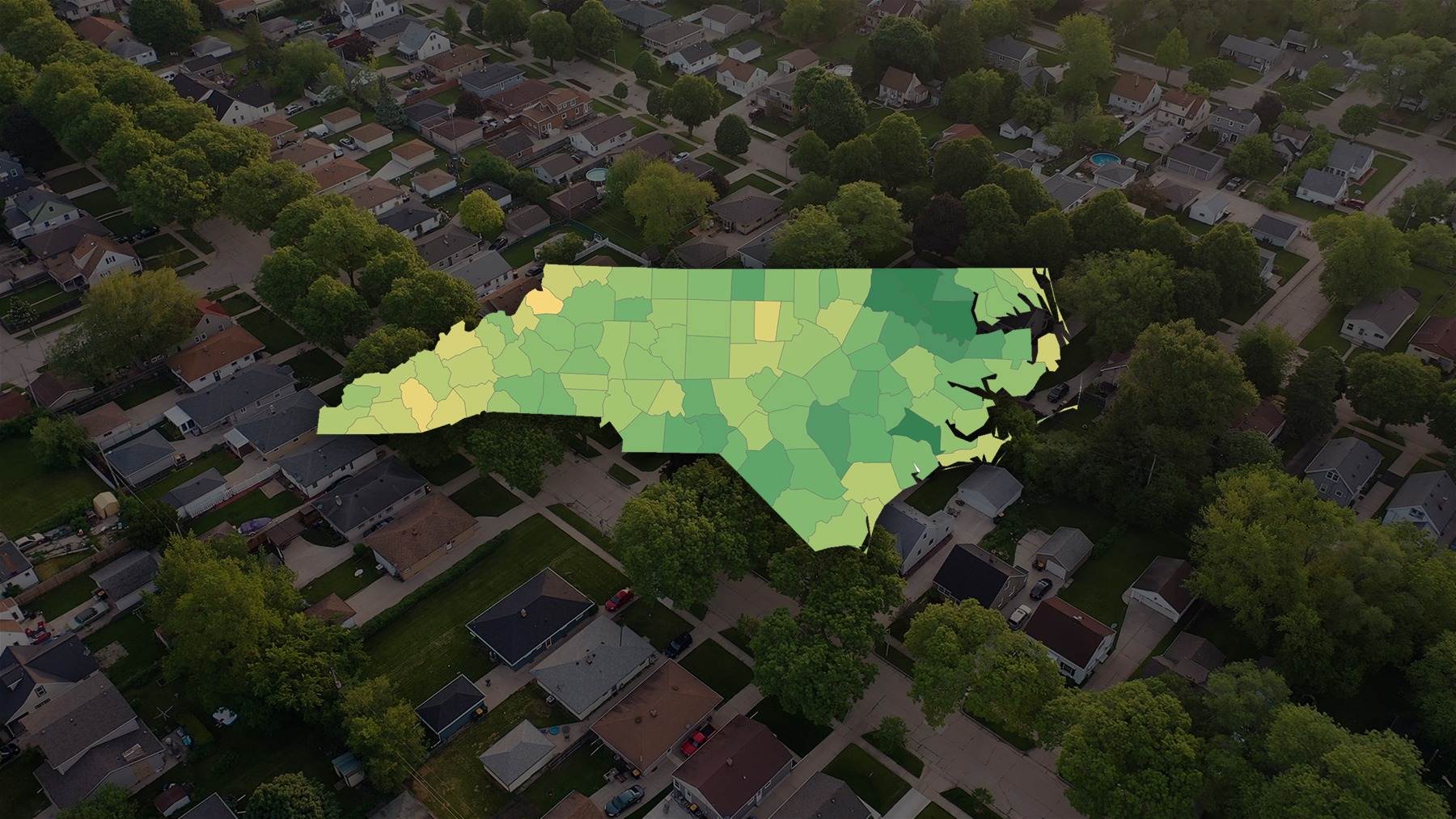


CHAPEL HILL, NC — North Carolina’s housing is projected to become slightly more affordable over the next two years, with the Housing Affordability Index rising from 98.6 to just over 100. A score of 100 represents the threshold at which a typical household would spend 30% of its income on payments for a median-priced home.
The new forecast by the North Carolina Economic Forecasting Initiative at the Kenan Institute of Private Enterprise shows North Carolina’s single-family home prices remaining elevated above pre-pandemic levels, though affordability still varies widely among counties. In many areas, household incomes are growing faster than home prices, offering modest relief to prospective buyers despite elevated mortgage rates. Elsewhere, particularly along the coast and mountains, limited housing supply and strong demand continue to drive prices higher.
Key Findings
- Wake and Mecklenburg counties largely match the overall state trend, while Guilford County is projected to become slightly less affordable, with the index falling from 106.8 to 104.1.
- Affordability is projected to improve the most in Coastal Plain counties Bertie, Bladen, Scotland, Edgecombe and Nash. Other areas we expect to have improving affordability include counties surrounding the Charlotte metro area such as Cleveland, Anson and Cabarrus.1
- Buying a home will become less affordable for typical households in many smaller counties in the Tidewater region, such as Northampton, Gates, Tyrrell, Hyde, Craven and Pamlico.
- Watauga, Jackson, Transylvania, Orange and Dare counties remain the most expensive counties in which to buy a home in the state, while Bertie, Jones, Halifax, Northampton and Martin counties are among the most affordable.
“The improvement in housing affordability is losing momentum across North Carolina,” said Kyle Henson, research economist for the North Carolina Economic Forecasting Initiative. “Household incomes are still gaining ground on home prices in many counties, but elevated mortgage rates will continue to stretch buyers’ budgets. We expect modest progress through 2027, with substantial differences across communities and little prospect of returning to pre-pandemic affordability.”
The Housing Affordability Forecast projects the initiative’s Housing Affordability Index by forecasting home prices, household incomes, mortgage rates and property taxes, incorporating local labor and housing market data alongside US Treasury rates. Index values above 100 indicate that monthly payments account for less than 30 percent of income, and values below 100 indicate that payments exceed this benchmark. While not a measure of whether any one household can afford to buy a home, this index is a point-in-time measure of housing costs’ strain on a typical household’s finances.