


- Adult learners are reshaping enrollment trends as colleges expand flexible programs and outreach to meet rising demand for short-term credentials.
- Dual enrollment offers early access but low yield, prompting new efforts to retain Career & College Promise students after high school graduation.
- Employer partnerships are driving program design, with industries co-creating curricula, sponsoring training and accelerating job pipelines.
- Wraparound supports and proactive advising are improving retention, especially among working adults and first-generation students.
- System-level barriers, like rigid funding models and fragmented pathways, limit scale, especially for rural institutions.
- Colleges are rebranding through trust-based outreach and digital marketing, reframing community college as a first-choice destination.
After years of enrollment decline, North Carolina’s community colleges are experiencing a drastic shift. New learner populations, labor market demands and policy innovations are transforming how colleges approach student recruitment and retention.
Recent research from the Kenan Institute of Private Enterprise, drawing on interviews with 15 community colleges and five statewide stakeholders, highlights how North Carolina institutions are embracing flexibility, deepening employer partnerships and investing in holistic supports. At the same time, they face structural barriers in funding, advising and cross-system coordination.
As state policymakers and education leaders look to scale what works, this research offers a snapshot of a system in transition: resourceful, adaptive and central to North Carolina’s economic future.
Adult Learners Are Driving the Shift
Changing Demographics, Changing Needs
Adult learners are reshaping the enrollment landscape across North Carolina. In fall 2024, the state’s community colleges posted the highest enrollment jump in 15 years, with full-time equivalent (FTE) enrollment rising 6% overall. Basic skills programs saw a 12% increase, curriculum 7% and workforce continuing education 1%.
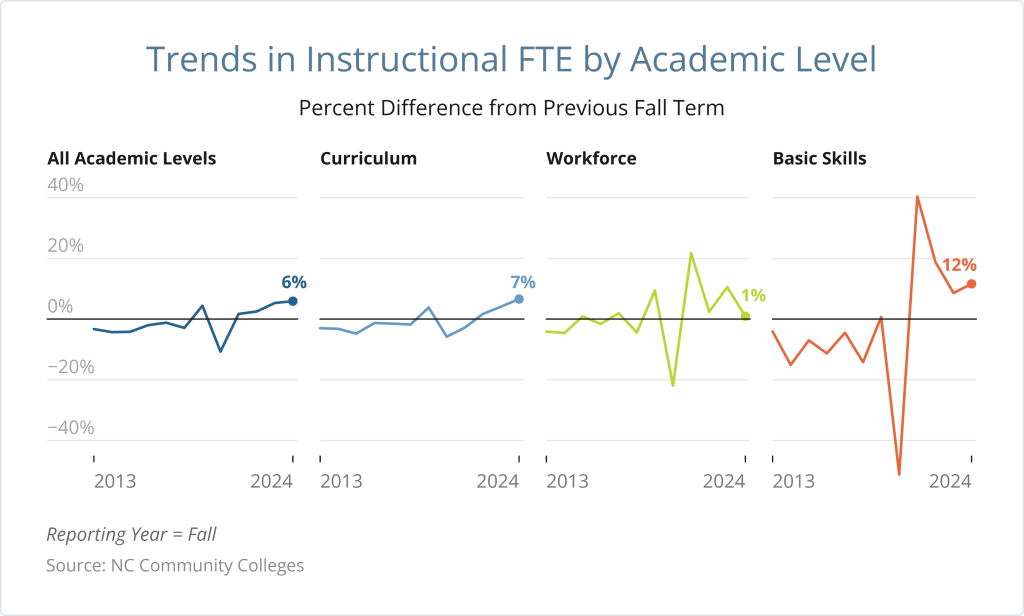
This growth reflects more than post-pandemic recovery. Colleges attribute it to career reevaluations, rising demand for short-term credentials and statewide initiatives such as NC Reconnect that aim to reengage working-age adults.
Flexible Formats and Focused Outreach
To meet adult learners where they are, colleges are redesigning delivery formats. Evening, weekend and hybrid course options are increasingly common, along with accelerated eight-week terms that allow working adults to focus on fewer courses at a time.
Targeted outreach is also key. Staff call former students, set up shop at workplaces and partner with local employers to reintroduce college as a viable option. Many colleges report increased enrollment among working mothers, older adults and underrepresented populations, groups that have traditionally been underserved by higher education.
Dual Enrollment: A Growing Pipeline with Yield Challenges
A Surge in High School Participation
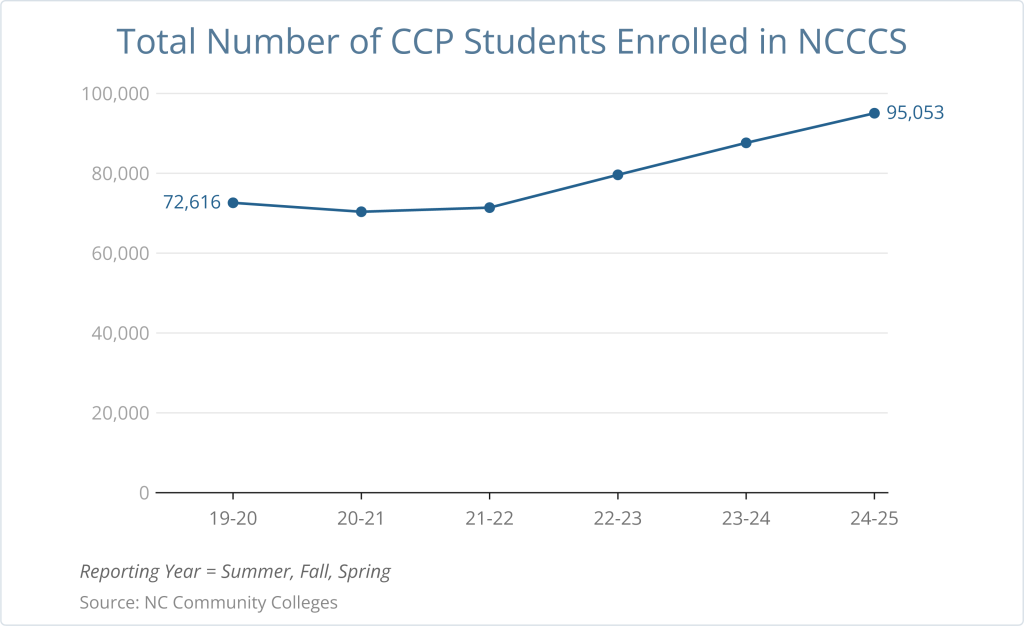
Participation in Career & College Promise (CCP), a program that allows eligible North Carolina students to enroll in college classes through their high school, has grown rapidly. Some campuses report that program students now make up nearly half their enrollment. These students graduate from high school with certificates or associate degrees already in hand, saving time and tuition.
The Flip Side of the Pipeline
But this early access comes with a tradeoff. Many program students bypass community colleges entirely after high school, enrolling directly in four-year institutions.
As one administrator noted, “They leave us for a four-year school at 18 with lots of credits, so we have to get creative to keep them coming back.”
To convert these students into full-time community college enrollees, some colleges are offering tuition scholarships, early advising interventions and stackable pathways, which allow students to earn multiple credentials. Still, many see the program less as a short-term enrollment booster and more as a long-term investment in college-going culture.
Employers Are Shaping the Student Experience
Employer partnerships are a defining feature of today’s community college landscape. Colleges are working hand in hand with local industries to co-develop curricula, build training centers and design earn-and-learn apprenticeships.
Examples range from a heavy equipment operator academy developed with county government to a precision machining lab created with a global aerospace firm. Advisory boards help keep programs aligned with real-time job demands, while employers often sponsor equipment, training slots or student stipends.
Policy Support Is Accelerating Alignment
State initiatives like NC Community Colleges Boost and the proposed Propel NC funding model aim to further align programs with high-demand sectors such as healthcare, advanced manufacturing and public safety.
Yet rural college leaders warn that without adjustments for population density and per-student service costs, these funding models could penalize smaller institutions, even when they meet workforce outcomes.
Retention Through Wraparound Support
Many colleges attribute recent enrollment growth more to improved retention than to new recruitment. Wraparound supports, including food pantries, transportation stipends, childcare, emergency grants and embedded success coaches, are helping students stay enrolled and succeed.
Flexibility also plays a retention role. Some colleges allow students to pause enrollment midterm or access late-night tutoring and advising. Early alert systems flag potential dropouts, allowing proactive outreach before issues escalate.
As one student services leader put it, “We try to anticipate their needs with wraparound services from Day 1, so no one walks alone on their education journey.”
Changing the Narrative: Marketing and Outreach Reinvented
Colleges are investing in creative marketing to challenge the “last resort” stigma still associated with community colleges. That includes social media campaigns, text-based outreach and CRM systems for personalized follow-up.
Recruitment now occurs everywhere, including grocery stores, church events and door-to-door canvassing in rural neighborhoods. Bilingual workshops, family nights and storytelling campaigns help build trust, especially among first-generation students.
“We can’t sit back and wait,” one outreach coordinator said. “We’re out in the community showing folks that college is for them.”
Systemic Barriers Limit Scale
Despite widespread innovation, structural barriers remain. These include:
- Misaligned funding models that penalize part-time enrollment.
- Overstretched advising staff serving caseloads of 300–500 students.
- Fragmented systems between K–12, community colleges and workforce partners.
Even successful pilot programs, such as one-stop success centers or employer-funded scholarships, often rely on time-limited grants, making sustainability a constant challenge.
Real-World Implications and Policy Recommendations
The findings point to clear, actionable strategies for state and local stakeholders:
- Scale flexible formats and adult-focused reengagement efforts.
- Treat Career & College Promise students as long-term prospects, not short-term boosts.
- Support rural colleges in funding models to ensure equity.
- Institutionalize wraparound supports proven to boost persistence.
- Convene regional ecosystems that align employers, colleges and schools.
Conclusion: A System in Transition, Poised for Impact
North Carolina’s community colleges are doing more than simply recovering enrollment. They are reinventing how higher education serves real people in real communities.
With sustained investment, structural reform and cross-sector coordination, the innovations already underway can become the new normal. In doing so, the state can solidify its community colleges as engines of economic mobility, workforce development and inclusive opportunity.