


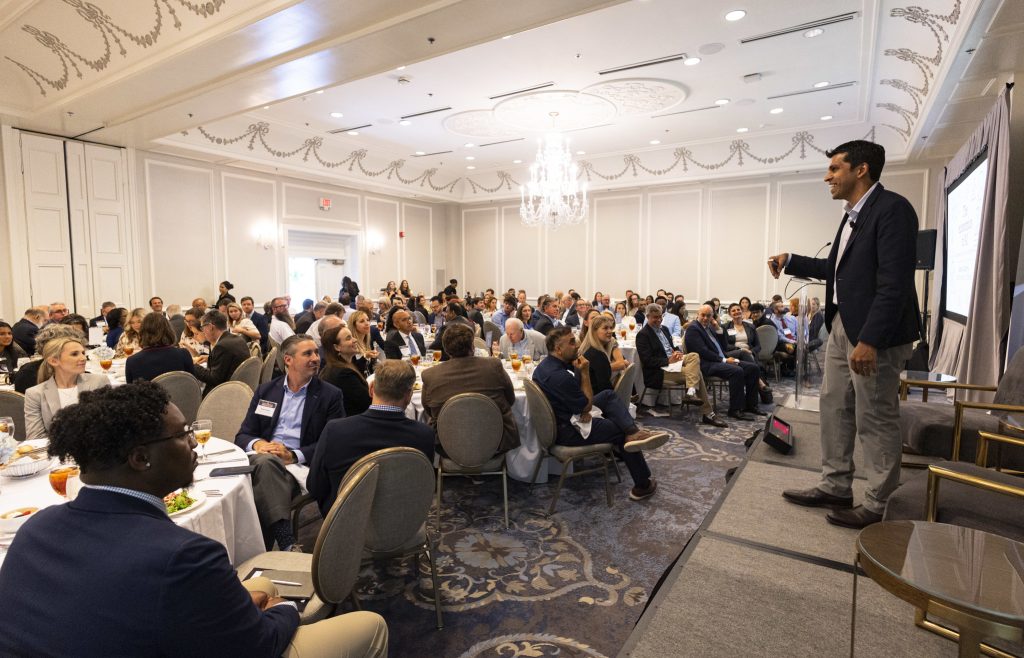
Frontiers 2025 is in the books, and yet the insights generated by the day’s conversations have only just begun to take root. Convening researchers and practitioners from academia, business, politics and nonprofits, Frontiers conveyed expert perspectives and empirical research on topics that pertain to America’s skills gap. Speakers and panelists discussed a multitude of business-related subjects, synthesizing experience-based knowledge and data analysis into theoretical and actionable solutions.
Throughout the day’s dialogue, common threads tied the vast collection of information together into practical parcels, providing the packed house with ideas for how to tackle the skills gap and build a more robust and resilient economy. From the rise of artificial intelligence to the redefinition of culture, here are four key insights from the conversations shaping the year ahead.
From Classroom to Career: Training for the Future
Broadly defined as the difference between the skills in demand and those being supplied, the skills gap can be separated into two facets: skill attainment and labor matching. Addressing skill attainment, many conference speakers pointed to new ways of thinking about and implementing training and educational systems. Work-based learning – training and educating workers on the job – is a proven strategy to build skills in a way that benefits workers, whose income is not disrupted by training, and firms, which develop the workforce they need from their own employee pool. Yet this approach, like other strategies to close the skills gap, is limited by industry buy-in and resources. Formal education systems need to have a greater focus on employable skills, while businesses need to invest in human – not just physical – capital, and individuals need to invest in themselves. Realizing these fundamentals will require alignment of goals and incentives, which compels leadership. State and local governments – and even economic think tanks – are well -suited to bring stakeholders together and facilitate dialogue, learning and resource sharing.
AI at Work: Innovation, Adaptation and the Human Factor
Many of the day’s presentations focused on the technological innovations of AI, perhaps the most conspicuous driver of the skills gap today. Frontiers attendees heard from researchers who presented cutting-edge empirical research describing AI’s meteoric rise and the potential implications for the nature of work. Cautious optimism characterized the conference’s expert opinions, as technological advancements tend to augment human labor, improving productivity and creating more roles for people to fill than jobs made redundant. Yes, AI is different from past innovations in the speed, scale and scope of its uptake and potential for disruption, yet economic upheaval is not inevitable. We are still in the early days of AI innovation, and the technology’s labor impacts have been muted so far. Major technological shifts demand thoughtful policy, planning and investment to help businesses, educators and individuals adjust to the changing skills market. In these enthusiastic times of AI promise and trepidation, the greatest risks may arise from overzealous capital expenditures toward unproductive applications of new technology.
People Power: How Demographics Are Redefining America’s Workforce
Despite technology’s significant place in many of the day’s discussions, the human element was Frontiers’ central focus. When we talk about skills, we mean the abilities of people to work productively. Demographic shifts are too often left out of conversations about our collective future, perhaps because many of its inherent factors are personally and politically sensitive: birth rates, aging and immigration, to name a few. No one likes to talk about growing old, even though it is a quintessential fact of life. Our aging workforce has dramatic implications for the global economy, with impacts that businesses, governments and societies must prepare for. Succession planning is more important than ever, as firms need to arrange not only transfers of leadership roles but also transmission of knowledge and skills from senior to junior workers and vice versa. Current policy is well behind where it needs to be and is even counterproductive in many instances, given the demographic challenges we face. In this area, technology is a potential bright spot, as productivity gains help to ease the strain on a shrinking working-age population supporting both young and elderly dependents.
Culture as a Catalyst: How Community Powers Business Growth
The relationship of business with community permeated the day’s discussions, and the notion of culture blanketed every story and bit of wisdom dished out by C-suite executives, public representatives and civic leaders alike. Within firms, establishing a culture that is open to people and their abilities, new ideas and ways of working is necessary for long-term survival and growth. Extending this openness beyond company walls and balance sheets to include a broader community and purpose is not only a moral imperative but one that makes business sense. It is in a company’s self-interest to help its community thrive because private sector success is enmeshed with a prosperous public. After all, workers and their skills come from the community, as do customers and their purchasing power. Economic strength and societal vitality are, in this way, both upstream and downstream from business culture and values. The greatest opportunities and risks to these interdependent engines of our economy may stem from harmful cultural shifts. The devaluation of human ingenuity, for example, or the loss of connection between communities would hurt not only the people whose skills and knowledge stand to be diminished but also the human-centered businesses and institutions that form the backbone of a prosperous society.
As the Frontiers of Business Conference made clear, progress depends on how boldly we bridge innovation and inclusion. The future isn’t waiting – it’s being built now, one idea at a time.
Stay informed – subscribe to our mailing list for updates on new thought leadership and Kenan Institute events. And mark your calendars: The Frontiers of Business Conference returns to The Carolina Inn on October 8, 2026. Details coming soon!