


Once the rare exception, flexible work arrangements are now the standard for a large segment of the US workforce. Before the COVID-19 pandemic, about 5% of paid full days were worked off-site. Now, more than a quarter of days worked in the US are done from home and 38% of employees have either hybrid — where the workweek is split between a shared office space and home — or fully remote positions.1
Percentage of Paid Full Days Worked From Home
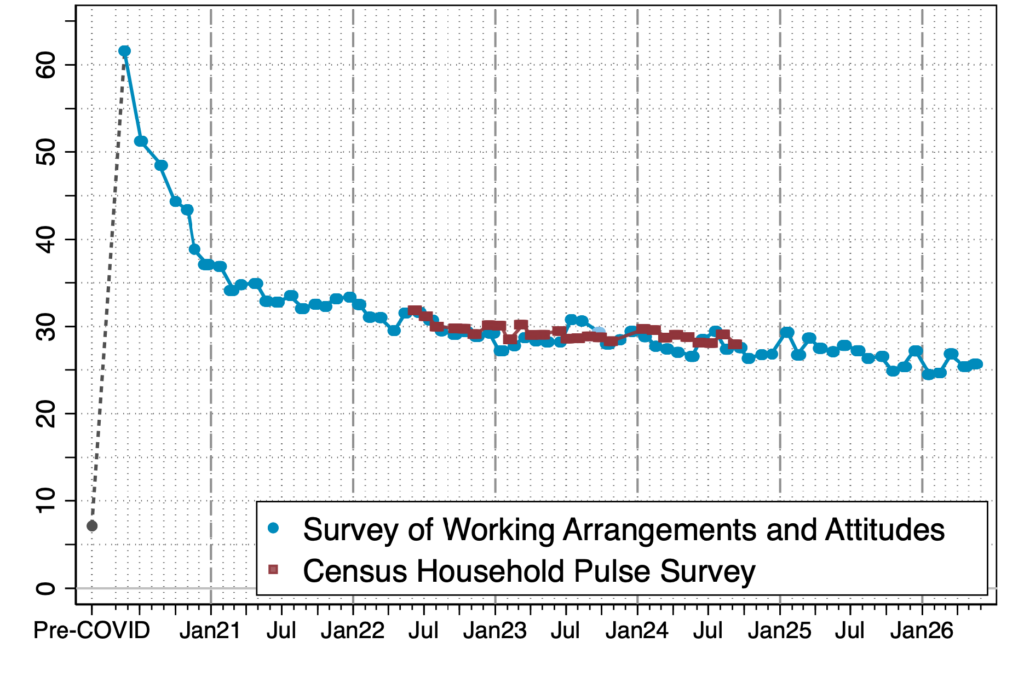
Image Long Description
The image is a line graph illustrating the trend in the percentage of paid full days worked from home over time. The vertical axis represents the percentage, ranging from 0% to 70%, while the horizontal axis spans from “Pre-COVID” to January 2026. Two data series are depicted: one represented by blue dots, labeled “Survey of Working Arrangements and Attitudes,” and another indicated by red squares, labeled “Census Household Pulse Survey.”
The graph shows a significant decline in the percentage of days worked from home at the onset of the pandemic, descending from over 60% to about 10%. After that, the percentage gradually stabilized, with the blue line fluctuating slightly around 30% and the red square line generally hovering around 20-30%. The background features a grid that aids in reading the plotted data points.
While flexibility’s staying power is evident, the future of work arrangements is anything but certain. Return-to-office mandates from corporate giants such as Amazon, AT&T and JPMorgan Chase show that the norms and policies deciding when and where we work are still in flux. Most large firms maintain some sort of flexible work arrangement, yet business leaders still express unease about remote work and its effects on productivity, innovation, team cohesion and corporate culture. It seems that employers and employees have yet to find an optimal equilibrium between working remotely and working from a shared space.
To delve into this conundrum, we have enlisted Stanford economist and 2026 Kenan Institute Distinguished Fellow Nicholas Bloom, an expert on remote and hybrid working arrangements. His research and commentary help us examine flexible work today, with the aim of answering key questions: Which jobs are best suited to flexible work arrangements? What firm-level protocols boost flexibility’s benefits and preclude its pitfalls? In what ways will technological change continue to transform the way we work?
What the Evidence Says About Flexible Work
Flexible work arrangements are now more common than ever, yet working from home remains a privilege. Not all jobs can be done remotely, and remote work is most prevalent in so-called white collar fields such as finance, technology, and professional and business services. Meanwhile, if you work in construction, manufacturing, retail trade, or hospitality and food services, you are far less likely to work from home.2 Educational attainment is a clear distinguishing factor separating the roles that are work-from-home eligible from those that must be done on site. Around half of workers with a four-year college degree and more than 50% of those with graduate-level degrees occupy either hybrid or fully remote positions. Meanwhile, more than 70% of workers with one to three years of college experience and 75% of those without any college experience work fully on site.3
Current Working From Home: All Wage and Salary Employees
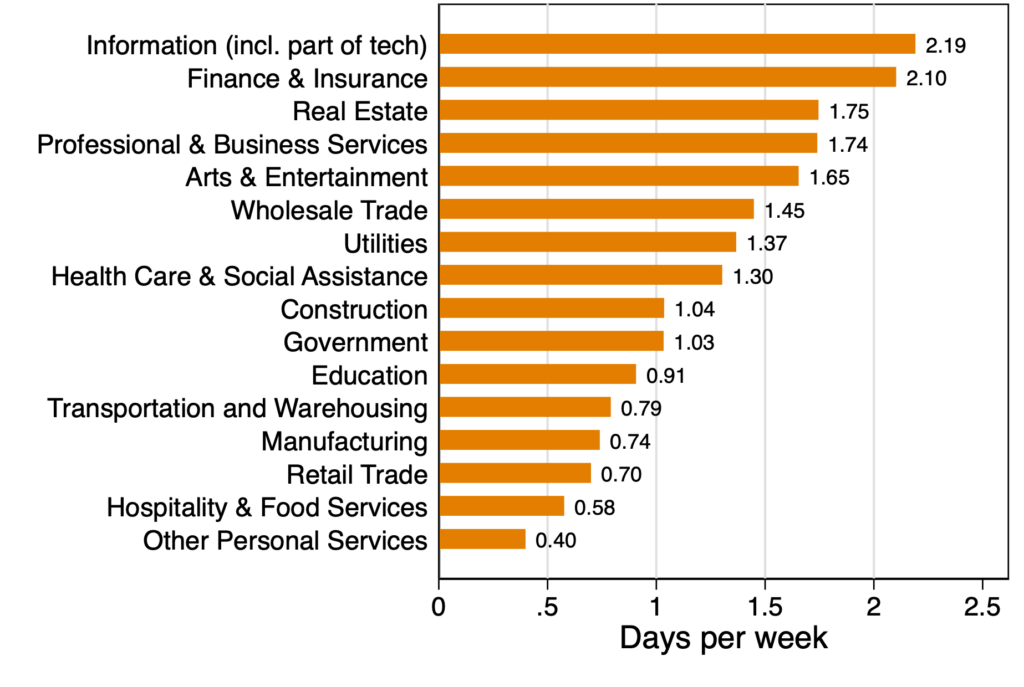
Image Long Description
The image displays a horizontal bar chart titled “Current working from home: All wage and salary employees.” The chart illustrates the average number of days per week that employees in various sectors work from home. The x-axis represents the number of days per week, ranging from 0 to 2.5, while the y-axis lists different sectors, including “Information (incl. part of tech),” “Finance & Insurance,” and “Other Personal Services.” Each bar is colored in a bright orange hue, with varying lengths corresponding to the average days worked from home. The longest bar, representing the “Information” sector, reaches 2.19 days, while the shortest, “Other Personal Services,” is at 0.40 days.
Considering these trends, it is unsurprising that people who work from home tend to be older, whiter and wealthier than those who commute to work every day.4 One recent study found that people who work from home earn on average 12% more per hour than fully on-site workers.5 This advantage largely stems from the types of jobs that can be done remotely and the inherent characteristics of those workers, including their baseline pay, educational attainment, gender and age. The rise of flexible work arrangements may thus raise equity concerns — is it fair that certain segments of the workforce work from home while others must work on-site full time?
Working Arrangements by Education
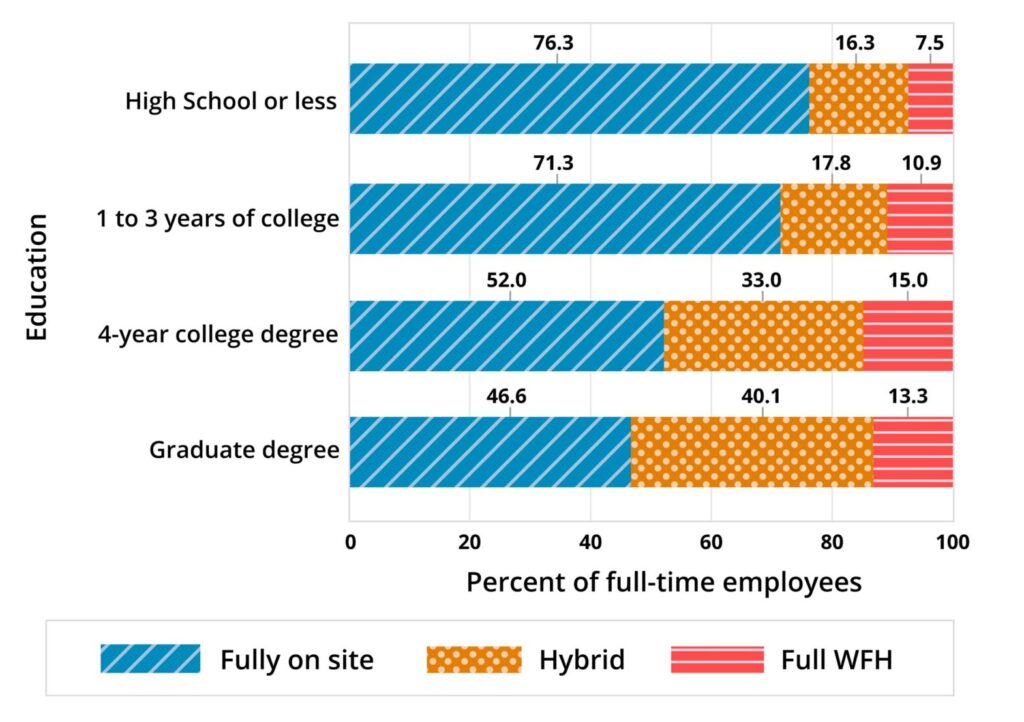
Image Long Description
The image is a bar graph titled “Working Arrangements by Education.” It displays the percentage of full-time employees working in three arrangements—Fully on-site, Hybrid, and Full Work From Home (WFH)—across different educational levels. The graph is divided into four horizontal sections, each labeled with different categories of educational attainment: “High School or less,” “1 to 3 years of college,” “4-year college degree,” and “Graduate degree.”
Each bar shows three segments with distinctive colors:
- Fully on-site is represented by a blue bar with horizontal stripes
- Hybrid is depicted with an orange bar featuring small dots.
- Full Work From Home uses a striped red bar.
The heights of the segments indicate the percentage of employees in each working arrangement, with values provided on the right side of each bar. The largest portion of employees working fully on-site is seen in the “High School or less” category, while the “Graduate degree” category shows a significant portion in the Hybrid arrangement.
Advocates of flexible work arrangements temper these concerns, pointing out that working from home can create more equitable outcomes by opening work opportunities to groups who in earlier times would not be able to join the workforce.
“The people in the US that benefit most from work from home are those with a disability,” says Bloom, whose research has shown that for every percentage point boost in the prevalence of working from home, full-time employment for individuals with a physical disability increases by 1%.6 Mothers too have benefited from the increase in flexibility. Studies show that the advent of work from home has allowed mothers to remain in the labor force at higher rates than they otherwise would.7
In theory, labor market dynamics would take care of equity concerns across the economy, and workers whose job requires their physical presence full time should see pay increases commensurate with these demands. We can see these dynamics at work: Employers advertising on the popular job site ZipRecruiter receive more than three times as many applications for positions with remote capabilities as for similar in-person roles.8 Meanwhile, the companies vying to get workers back into the office full time are compensating them with higher pay — as much as 33% higher according to ZipRecruiter data — and greater promotion opportunities.910
Fairness is a key concern when establishing work arrangement policies, as morale and engagement often depend on employees’ feeling that they are treated equally. Yet flexible work’s effects on productivity remain the weightiest question for business heads. Debate persists over the productivity question because, while everyone has anecdotes to draw from, there is little strong evidence for or against.
“There’s very little rigorous causal analysis,” Bloom says, “because almost no one has done experiments on this.” In this data desert, Bloom’s research is an oasis of science-backed evidence supporting hybrid work’s capacity to enhance profitability. Bloom and his international collaborators have examined working from home’s effects on workers and firms, finding that hybrid work arrangements can boost productivity by eliminating wasteful commutes and through the home environment’s ancillary benefits. The research indicates that the quiet of the home office is good for getting work done. Working next to your coworkers, it seems, can be distracting.11
Other studies show a positive association between remote work and total factor productivity growth, with large variance across industries.12 Yet hybrid work’s supporters have little need to cite these studies because, as Bloom points out, we can simply look at the actions of most large private companies. The global economy is its own sort of laboratory, providing evidence that firms prefer at least some remote work because allowing workers to work remotely improves capital and labor allocation. Bloom’s research finds evidence of flexible work’s benefits accruing to firms in the form of improved retention and recruitment.
“After allowing workers to work from home,” Bloom says, referencing his landmark 2024 study published in Nature, “quit rates went down by 35%. And this is good news for the company because every person that quits costs them about $50,000.”13 He believes that this benefit, more than any other, points to why hybrid work has become the norm for two-thirds of Fortune 500 companies. “Hybrid has become the standard because it’s profitable,” he contends. “It reduces turnover, and turnover is very expensive.”
WFH cut attrition by 33% overall, and had a particularly strong effect for non-managers, women and those with longer commutes.
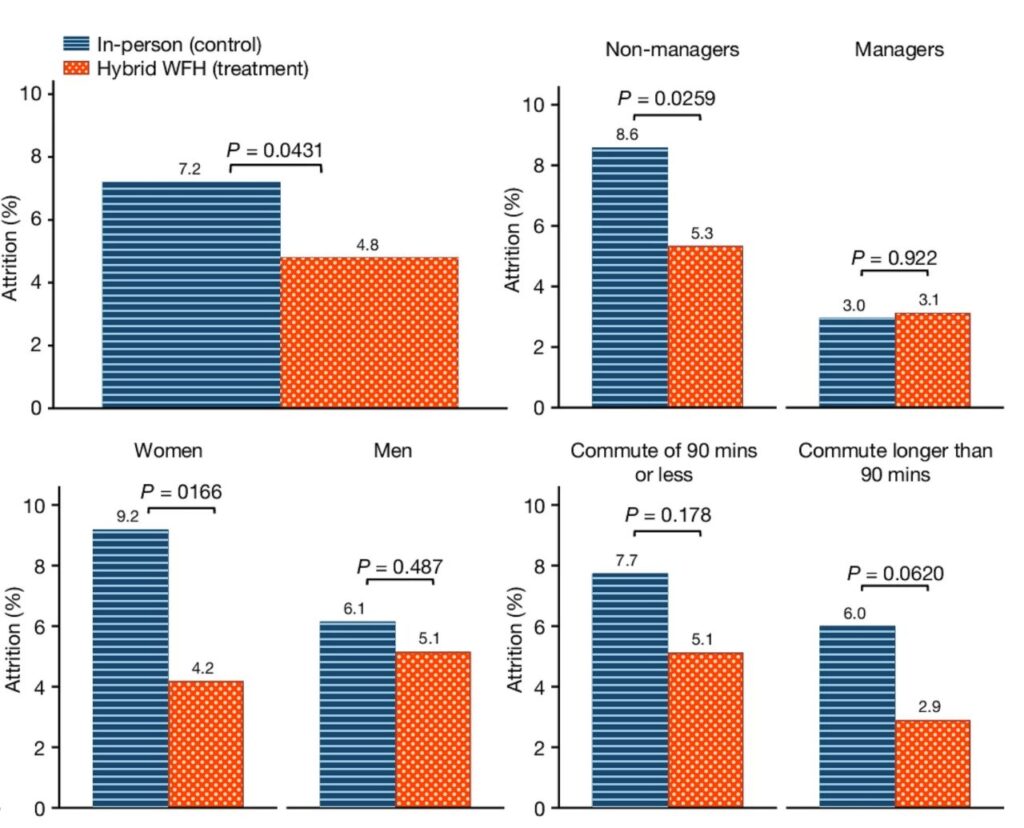
Image Long Description
The image is a bar chart comparing employee attrition rates between different groups and working conditions. It is divided into four quadrants, each focusing on a specific demographic or scenario. Each bar represents the percentage of attrition (ranging from 0% to 10%) for two conditions: “In-person (control)” represented by solid blue bars and “Hybrid WFH (treatment)” represented by dotted orange bars.
- The top left quadrant compares attrition between women and men. The bar for women shows 7.2% for in-person and 4.8% for hybrid WFH, with a p-value of 0.0431.
- The top right quadrant compares non-managers and managers. Non-managers have an attrition rate of 8.6% in person and 5.3% with hybrid WFH (p = 0.0259). Managers exhibit a smaller difference with 3.0% in person and 3.1% hybrid (p = 0.922).
- The bottom left quadrant illustrates attrition for women (9.2% in person vs. 4.2% hybrid, p = 0.166) and men (6.1% in person vs. 5.1% hybrid, p = 0.487).
- The bottom right quadrant evaluates attrition rates based on commute lengths: those with commutes of 90 minutes or less show 7.7% for in-person and 5.1% for hybrid (p = 0.178), while those with commutes longer than 90 minutes display 6.0% in person and 2.9% hybrid (p = 0.0620).
Each bar is labeled with the specific attrition percentage above it and the corresponding p-value indicating statistical significance.
Fully remote work, adopted by about 10% of workers, has effects notably different from those of hybrid arrangements. Bloom finds that fully remote work can be associated with an approximate 10% drop in productivity relative to similar fully in-person jobs. Yet going fully remote remains popular because these arrangements generate tremendous cost savings for the implementing firms, which save on space and labor costs. A digital communications company based in New York City, for instance, stands to save big by maintaining the smallest possible physical footprint and outsourcing the work to somewhere with lower wages.
Best Practices for Flexible Work
While no one solution fits all firms, there are essential best practices for flexible work policy implementation. First, Bloom views hybrid work arrangements as an optimal solution in most industries. Contending that the productivity problems associated with remote work are issues of management, he puts the onus on managers to unlock the extra productivity and cost savings associated with hybrid schedules.
“Fact one for companies,” Bloom asserts, “is they should focus on performance evaluations as soon as people have one or more days a week at home. If you want to have employees at home, you must evaluate outputs.” When managers cannot observe their subordinates directly, best management practices involve regularly scheduled check-ins with explicit, measurable performance goals and evaluations. The importance of performance evaluation, an essential management practice for any role, is even greater for employees who work from home.14
To maximize productivity, hybrid arrangements must align tasks with the right setting: individual work for the quiet home environment and collaborative work for in-person interactions. As Bloom emphasizes, this requires deliberate coordination so that teams’ in-office days overlap to avoid wasting costly commutes and opportunities to collaborate. With fewer in-office days, managers should be intentional about scheduling key interactions and hold employees accountable to fulfill in-person obligations and meet deadlines.
No matter the management practice, not everyone will be happy with the work arrangement. Some employers favor full-time in-office schedules for easier oversight or to justify expensive office spaces, and worker preferences also vary. Business leaders must choose the arrangement that best fits their firms and, once implemented, stick to it.
“Don’t change your policy,” Bloom says succinctly, rounding out his protocol for effective hybrid arrangements. In his surveys of firms navigating work arrangements, Bloom has observed that policy change is often unpopular and can be costly. “Moving policies around really messes companies up,” he notes, “because it misaligns who is in your firm with what they want. Changing policies is like moving your headquarters from New York one year, to Chicago the next, and then to LA. Every time you move, you misalign your employees with your firm.”
The Future of Flexible Work
Work arrangements — alongside pay and benefits — are now a central part of the employer-employee bargain, with tradeoffs on both sides.
Technology has expanded where and how people work, but firms must carefully manage the interplay between digital tools and people. Productivity and innovation gains must be balanced against the need to preserve human connection and professional development. Clear expectations, consistent performance management and strong communication will remain essential. The organizations best positioned to succeed will be those that pair flexibility with disciplined management.
Not all forms of work face the same future. Fully remote roles may be especially vulnerable to automation because the jobs that can be performed entirely off-site tend to be those that firms have historically outsourced and offshored. Bloom argues that these roles could be among the first replaced by artificial intelligence technologies.
Why Hybrid Work Has Staying Power:
A triple win for employers, employees and society

Employers
- Broader talent pools
- Stronger retention
- sustained productivity
- Lower turnover costs

Employees
- Greater flexibility
- Less time and money spent commuting
- Better work-family balance
Society
- Less traffic and commuting-related pollution
- Greater workforce access for people with disabilities and caregivers
- Broader economic and community benefits
Hybrid work has a different outlook. Bloom expects hybrid to remain a lasting feature of the workplace because it offers a rare “triple win” for employers, employees and society. Hybrid work can expand firms’ talent pools while improving retention and productivity; it gives employees greater flexibility and reduces commuting costs; and it generates broader social benefits like reduced traffic and pollution.15 The combination of business profits, worker gains and public benefit is why hybrid work arrangements will likely define the workplace for years to come.
1 Barrero, Jose Maria, Nicholas Bloom, and Steven J. Davis, 2021. “Why working from home will stick,” National Bureau of Economic Research Working Paper 28731.
2 Barrero, Jose Maria, Nicholas Bloom, and Steven J. Davis, 2021. “Why working from home will stick,” National Bureau of Economic Research Working Paper 28731.
3 Barrero, Jose Maria, Nicholas Bloom, and Steven J. Davis, 2021. “Why working from home will stick,” National Bureau of Economic Research Working Paper 28731.
4 Burrows, M., Burd, C. & Ismail, M. S. (January 15, 2025). “New U.S. Census Bureau Data Show Detailed Characteristics of Home-Based Workers.” U.S. Census Bureau.https://www.census.gov/library/stories/2025/01/work-from-home-inequalities.html
5Li, H., Sauvagnat, J., & Schmitz, T. (2026). The Work-from-home Wage Premium (No. 2026-02).
6 Bloom, N., Dahl, G. B., & Rooth, D. O. (2026). Work from home and disability employment. American Economic Review: Insights, 8(2), 179-195.
7 Harrington, E., & Kahn, M. E. (2026). Has the Rise of Work from Home Reduced the Motherhood Penalty in the Labor Market?. National Tax Journal, 79(2), 000-000.
8 Pollak, J. (October 11, 2025). “Remote or RTO?: Employers and Workers Meet in the Middle.” ZipRecruiter.https://www.ziprecruiter-research.org/annual-employer-survey-2023/remote-or-rto-employers-and-workers-meet-in-the-middle
9 Christian, A. (March 24, 2024). “U.S. salaries are surging for fully in-office jobs.” BBC. https://www.bbc.com/worklife/article/20240322-us-salaries-higher-in-office-jobs
10 Confino, P. (October 5, 2023). “CEOs want employees back in the office, and 90% say they’ll likely give raises and promotions to those who actually show up, survey finds.” Fortune. https://fortune.com/2023/10/05/rto-return-to-the-office-remote-work-raises-promotions/
11Bloom, N., Han, R. & Liang, J. Hybrid working from home improves retention without damaging performance. Nature 630, 920–925 (2024).https://doi.org/10.1038/s41586-024-07500-2
12 Pabilonia, S. W. & Redmond, J. J. “The rise in remote work since the pandemic and its impact on productivity ,” Beyond the Numbers: Productivity, vol. 13 / no. 8 (U.S. Bureau of Labor Statistics, October 2024), https://www.bls.gov/opub/btn/volume-13/remote-work-productivity.htm
13Bloom, N., Han, R. & Liang, J. Hybrid working from home improves retention without damaging performance. Nature 630, 920–925 (2024).https://doi.org/10.1038/s41586-024-07500-2
14 Barrero, J. M., Bloom, N., & Davis, S. J. (2023). The evolution of work from home. Journal of Economic Perspectives, 37(4), 23-49.
15 Crawford, K. (June 12, 2024). “Hybrid work is a ‘win-win-win’ for companies, workers, study finds.” Stanford University Institute for Economic Policy Research (SIEPR). https://siepr.stanford.edu/news/hybrid-work-win-win-win-companies-workers-study-finds