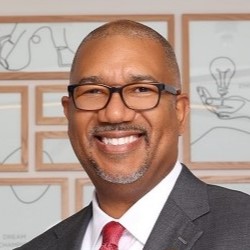


Banks and other financial institutions play a key role in providing communities with the resources to grow and thrive. We will explore this dynamic at the Kenan Institute’s Conference on Market-Based Solutions for Reducing Wealth Inequality, featuring a keynote from Kala Gibson, executive vice president, head of business banking and chief enterprise corporate responsibility officer at Fifth Third Bank.
Gibson’s experience shows how market‑driven community development investments, when paired with strong local partnerships, support neighborhoods, promote economic mobility and strengthen communities while improving the bank’s long‑term performance. He sat down with the institute to expound on how banks can address wealth inequality by strategically investing in affordable housing, revitalizing commercial corridors and expanding access to capital and opportunity for small businesses and workers.
Drawing on your extensive experience working in retail, community and small business banking, what do you believe is the role of financial institutions, such as Fifth Third Bank, in addressing wealth inequality?
Kala Gibson: Financial institutions play a critical role in addressing wealth inequality because we sit at the intersection of capital, communities and economic opportunity. At Fifth Third, we believe our responsibility goes beyond meeting regulatory requirements — we have an obligation to intentionally deploy our financial, intellectual and social capital in ways that expand access and remove long-standing barriers to opportunity.
In what ways do banks support the communities around them? What additional supportive efforts should banks be making?
Kala Gibson: Banks support communities in many ways — through mortgage and small business lending, community development investments, financial education, volunteerism and partnerships with local organizations. These efforts matter, but they are most effective when they are coordinated, sustained and grounded in community voice. What more banks should be doing is moving from transactional engagement to transformational partnership. That means concentrating resources rather than spreading them thin, measuring outcomes rather than just dollars deployed, and committing for the long term. At Fifth Third, our experience has shown that when we align lending, philanthropy and expertise around shared neighborhood goals, we can catalyze broader investment and lasting change.
What initiatives has Fifth Third Bank undertaken to support small businesses and the communities these businesses anchor?
Kala Gibson: We support small businesses by expanding access to capital, including US Small Business Administration loans and partnerships with local community development financial institutions, as well as offering technical assistance either through us or in partnership with others. Through our place-based model, we’ve actually innovated in multiple ways for small businesses. The Fifth Third Small Business Catalyst Fund — a unique fund that we funded with philanthropy and through partnership with community development financial institutions — actually came from our Neighborhood Program. Through the Catalyst Fund, we are able to make both grants and loans to support small businesses.
Would you speak to how your Neighborhood Program supports upward mobility and how you as a financial institution decided to invest directly in neighborhoods?
Kala Gibson: We chose to invest directly in neighborhoods because we saw that place matters. Economic outcomes are shaped by where people live — the quality of housing, access to jobs, availability of services and strength of local institutions. The Fifth Third Neighborhood Program was designed to address these interconnected factors through a focused, ecosystem-based model. By investing in affordable housing, revitalizing commercial corridors, supporting workforce development and strengthening local partners, the Neighborhood Program helps residents build stability and opportunity where they are. Our goal is not short-term impact but long-term upward mobility — helping people remain in their neighborhoods as they improve, build wealth and participate fully in their local economy. That is how we believe banks can contribute meaningfully to reducing wealth inequality.
Would you tell us why you partnered with the Kenan Institute on an evaluation of the Fifth Third Neighborhoods Program? What have you learned from this evaluation?
Kala Gibson: We asked Kenan to evaluate our Neighborhood Program because we wanted an independent, credible assessment of our place-based approach — one that would both validate what’s working and challenge us to do better. From the beginning, we were clear that the Neighborhood Program was not meant to be static. It was designed to evolve, and that requires honest evaluation. The insights gleaned from the white paper are shaping how we refine, expand and share this model going forward. We hope that it becomes one of the tools in our toolbelt to encourage other banks to join us in this important effort.
In what ways do governing bodies, civil society and community groups engage with banks to achieve the common goal of bottom-up wealth creation? What more should be done to strengthen this working relationship?
Kala Gibson: Bottom-up wealth creation happens when governing bodies, civil society, community organizations and financial institutions work as true partners. In our Neighborhood Program, local nonprofits, community development organizations and civic leaders help identify priorities, lead implementation and ensure accountability to residents. Public entities often help align policy, infrastructure and funding, while banks contribute capital, expertise and convening power. These relationships are the most effective when roles are clear and power is shared.
What policies, programs or approaches have worked to improve upward mobility and financial health for underserved households and communities?
Kala Gibson: Our experience — and the findings from the Kenan Institute — shows that approaches centered on place, partnership and people are most effective. Policies and programs that integrate affordable housing, small business support, workforce development and financial access create reinforcing benefits that improve household stability and economic mobility. Specifically, place-based strategies that concentrate resources, elevate resident voice and strengthen local institutions have shown promise.