

- Anchor institutions are economic engines. Schools are the largest employers in half of North Carolina counties, and small businesses have created two thirds of the state’s net new jobs in the past 25 years. When they falter, entire communities feel the ripple effects.
- Current funding systems aren’t built for speed. Schools can’t borrow for most emergency needs, and small businesses often face long waits or burdensome loan terms from federal aid.
- Flexible, fast capital makes the difference. Philanthropy and community funds that deliver money within days can be game changers.
- North Carolina can formalize new models. Local funders, business groups and policymakers can build standing mechanisms that provide bridge funding, replicate unrestricted-giving models and safeguard long-term prosperity.
On September 27, 2024, Hurricane Helene tore through Western North Carolina, washing out roads, shutting down schools and destroying small businesses. Avery, Mitchell and Yancy counties, in the northwestern part of the state, experienced wind gusts of 100 mph and up to 24 inches of rain. These communities scrambled to get their anchor institutions — the schools that employ hundreds and educate thousands and the local businesses that keep downtowns alive — back online. Some found creative ways to reopen quickly, while others struggled to secure the flexible funding needed just to rent toilets or restock shelves.
These stories reveal a bigger truth: Anchor institutions, whether public schools or small businesses, are more than neighborhood fixtures. They are economic engines, talent pipelines and community stabilizers. When they falter, the ripple effects threaten North Carolina’s broader prosperity. Yet our current funding systems are not built for speed or flexibility, leaving many anchors vulnerable after disaster strikes.
This piece explores how schools and small businesses recover differently, why the right kind of capital matter, and which models North Carolina can look to in order to strengthen community and economic resilience.
Anchor institutions define our communities. From the elementary school you take your child to each day to the bagel shop that becomes a Saturday morning tradition, these institutions make our towns and our neighborhoods special. They also drive local economies: School districts are the largest employer in nearly half of North Carolina’s counties,1 and small businesses have created two-thirds of the state’s net new jobs over the past 25 years.2
But what happens when disasters hit our communities and the long-term survival of the institutions is called into question, whether due to the cost of rebuilding the institution or a shift in behavior because the institution went away for a period of time? How can we develop systems and partnerships to quickly deploy flexible capital at moments when the absence of short-term funds could reshape a community’s economy for decades?
The definitions of anchor institutions range from organizations that “invest in their communities as a way of doing business”3 to those that “serve as social glue, economic engines or both.”4 In practice, they are schools and small businesses — very different organizations that nonetheless serve as community anchors. Both matter deeply, but their ability to access capital differs sharply. That means a one-size-fits-all approach won’t work.
A Short Primer on School Funding
One key way that North Carolina’s public schools differ from small businesses (and even from local governments) is how they access money. The state is responsible for funding public school instructional and operational expenses like personnel, instructional materials and transportation. Counties fund capital expenses like buildings and maintenance and are increasingly stepping in to cover instructional costs as well.5 School boards submit a district budget to the board of county commissioners, which makes the final decision on how much funding to provide as part of the county’s annual budget.
School districts do have fund balances or “rainy-day funds” to cover emergency costs, particularly related to facilities. But the fund balances can be funded only through local dollars, and the size of the balances varies greatly by district. For most government entities, one way to increase revenue is to increase taxes. School districts in North Carolina do not have this authority.
Perhaps even more limiting, particularly in times of disaster, is the fact that the legislative statutes sets the parameters for how local governments in North Carolina can take out loans. For public schools, this authority is especially narrow. Local boards of education may borrow only for specific purposes outlined in North Carolina General Statute § 115C-528: automobiles, school buses, mobile classroom units, food service equipment, photocopiers, athletic lighting, and computers or related technology. With the exception of mobile classroom units, these types of purchases do not line up with the types of purchases districts need to make in times of disaster.
Moreover, districts must secure board of county commissioner approval if the repayment period exceeds three years or if the total amount financed over any three-year period is more than $250,000 or three times the local board’s annual state allocation for classroom materials, whichever is less. This combination of narrow borrowing authority and approval hurdles leaves school districts with very limited funding autonomy compared with other anchor institutions.
Hurricane Helene’s Impact on Anchor Institutions
In the aftermath of Helene, anchor institutions worked quickly to develop a plan for reopening in some capacity to provide stability in communities upended by the floods.
Disasters have a way of shining a light on challenges that any organization faces. For instance, schools cannot reopen without toilets and a place to wash hands. Districts looked for temporary toilets and handwashing stations, but they came at a high cost, with one estimate coming in at $214,245 for seven days of rental. Just two weeks of rental — only one cost related to reopening — could wipe out a small district’s entire fund balance.
The Community Foundation of Western North Carolina played a critical role in getting quick, flexible funding to public service entities post-Helene. The foundation began deploying grants on October 7, 2024 — just 10 days after Helene hit. As of August 2025, it had distributed $38,650,015 through 526 Emergency and Disaster Response Fund Grants. The foundation’s novel approach included public agencies like schools as eligible recipients along with nonprofit organizations. It also gave applicants flexibility to use funds to meet immediate disaster response needs and distributed these funds quickly, often hitting bank accounts within one week of award notification.
Unlike schools, small businesses are typically not eligible for similar philanthropic funding opportunities and must wait for government grants or loans to cover losses. A January 2025 piece by the nonpartisan Milken Institute cites that “The Federal Emergency Management Agency (FEMA) estimates that 40 percent of small businesses never reopen after a natural disaster, and within one year, an additional 25 percent shut down.6 Like schools, these anchor institutions are unlikely to have a substantial fund balance. Many of these funding opportunities are either reimbursable (meaning you need cash for initial outlay) or require a loan term. The Small Business Administration offers loans to businesses in presidentially declared disasters to cover losses not covered by insurance.7 However, the collateral requirement and loan maturity (30 years) may be a limitation for some small businesses.
In some cases, communities come together to support these businesses with donations and in-kind support. Businesses like DT’s Blue Ridge Java in Spruce Pine and Old Orchard Creek General Store in Lansing chose to rebuild so that other businesses in their communities would do the same. The family-owned and -run coffee shop is documenting its rebuilding efforts on its website and has noted that community support, donations and encouragement have been essential in its journey. Like DT’s Java, Old Orchard Creek General Store is a community gathering place that faced a similar choice after Helene. In this short documentary produced by UNC-Chapel Hill graduate Maggie McIntyre, store owner Shelby Tramel sums up the importance of small businesses in places like Lansing and Spruce Pine: “Every single business has an outsized impact because there is only one of each thing. When you lose any one of the places in a place like Lansing, it has a much larger impact.” Tramel felt a responsibility to rebuild, and because of her leadership and extraordinary community-led efforts and investment, Old Orchard Creek General Store was the first business in downtown Lansing to reopen.
Together, small businesses not only represent a major share of job creation but also fuel the economic cycle of their communities: They generate jobs, support local suppliers, attract families and strengthen the tax base. Without them, communities risk losing not just storefronts but also the stability that keeps neighborhoods thriving. But do we want to rely on ad hoc fundraising efforts to fuel our communities’ economies?
Quick and Flexible Funding Is Essential Post-Disaster
Mebane Rash, CEO and editor-in-chief of EducationNC, captures the challenge: “There is a spell after an economic or natural disaster hits where, especially in small rural communities, the leaders are already overworked and underresourced, all of which makes the initial crisis period until state and federal resources start flowing really critical but also unreasonably stressful.”8
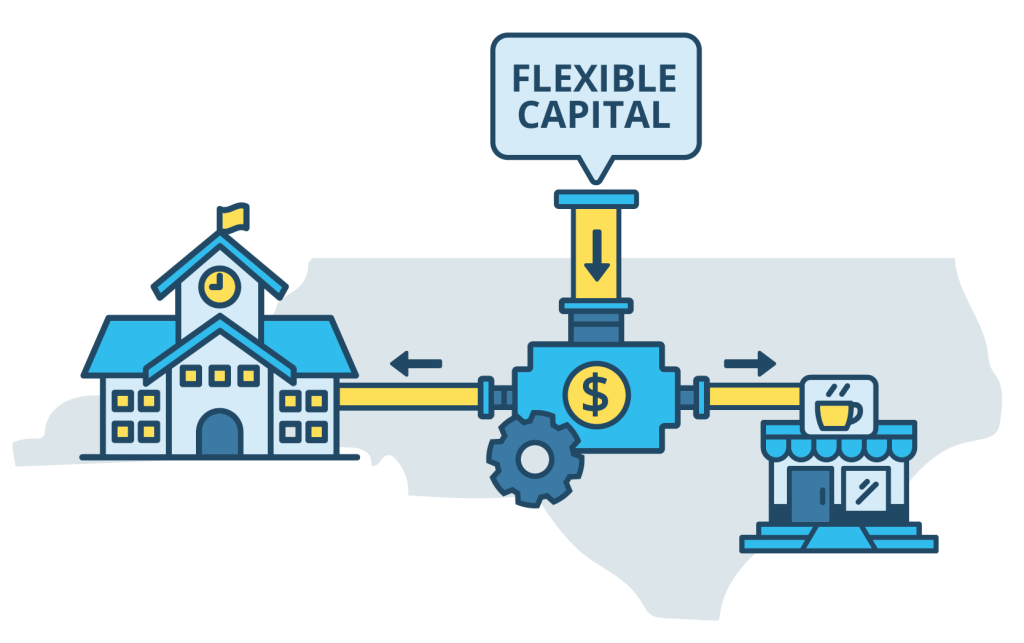
The support an anchor institution receives during this initial crisis period can be a game changer, and we have models that we can formalize so organizations can rely upon them in times of crisis. At the local level, we can replicate funding programs like that of Community Foundation of Western North Carolina — flexible funding that comes quickly to public agencies and nonprofits. Local philanthropies can also learn from the success of the Yield Giving/MacKenzie Scott model, which provides large-scale and flexible funding to vetted organizations. According to the Center for Effective Philanthropy, “Scott’s very large, unrestricted gifts – with few to no restrictions on the time in which they must be spent – have transformed recipient organizations and influenced many of the communities these organizations serve.”9 The center’s evaluation of recipient organizations found that “two years after grant receipt, organizations that received a grant from Scott have a median of twice as many months of operating expenses in cash reserves as comparable nonprofits.”10
Small businesses would benefit from access to a mix of loans and grants, and most importantly quick access to these funds. This funding will not (and should not) replace traditional funding from FEMA or the SBA, but rather provide a quick influx of cash to help the business begin recovery while it waits for other funds to come in.
Conclusion
Supporting local anchor institutions as they recover from natural disasters is not optional: It’s essential to North Carolina’s long-term prosperity. Employers, philanthropists and policymakers can improve resilience by formalizing quick, consistent and streamlined funding mechanisms. We cannot prevent disasters, but we can prevent community collapse – and rapid capital for schools and small businesses is one of the smartest resilience investments our state can make.
1 https://bestnc.org/wp-content/uploads/2024/07/2024-Facts-Figures-Digital-Version.pdf
2 https://sbtdc.org/impact/small-business-in-nc
3 https://pmc.ncbi.nlm.nih.gov/articles/PMC7002960/
4 https://www.newark.rutgers.edu/meet-rutgers-newark/and-newark/anchor-institution
5 https://www.ncforum.org/schoolfinance/
6 https://milkeninstitute.org/content-hub/insights/improving-small-business-disaster-response-and-recovery
7 https://www.sba.gov/funding-programs/disaster-assistance/physical-damage-loans
8 https://www.ednc.org/the-ongoing-role-of-philanthropy-in-western-north-carolina/
9 https://cep.org/wp-content/uploads/2025/02/CEP_Breaking_the_Mold_FNL.pdf