


- Work feels more transactional than it once did, and these sentiments reflect a weakening of the unwritten bargain between employers and workers that extends beyond explicit contracts.
- A more transactional workplace is not inherently a bad thing. Clear standards and explicit expectations strengthen accountability, but they cannot by themselves sustain the confidence and shared purpose that strong organizations depend on.
- When workers feel expendable, they tend not to give more than their job formally requires. An overly transactional employer loses out on creating a productive and vibrant workplace culture, as these traits can weaken collaboration, erode initiative and hinder innovation.
- The core challenge for employers and workers is not to restore an outdated concept of loyalty but to find a credible equilibrium between formal obligations and human understanding. Firms that handle advancement, flexibility and difficult decisions with clarity and consistency will be in the strongest position to maximize long-term growth and productivity.
Conventional wisdom says that work is more transactional now than in years past and that this change is a problem for firms and workers alike. Some data supports this conclusion, and whether true or not, there is a growing feeling that workers and firms do not care much beyond what they can extract from the other.
Yet vibes can be misleading. Despite the prevailing notion that the employer-employee relationship has become more transactional, when workers and firms are asked what they want from each other, their responses are reasonable and like those of earlier generations. Why then is there rising consternation on both sides of the employer-employee divide?
What Do We Mean by Transactional Work?
Balancing work’s necessary transactions with its less tangible culture-building attributes is an essential task confronting both firms and workers today. In business, productivity requires an adequately compensated workforce, yet innovation and a firm’s long-term prospects suffer when work is solely based on this quid pro quo. To find the right equilibrium, we first need to step back and define our terms.
Without connotation, “transactional” simply means an exchange or interaction between parties. In business, transactions are the central act of commerce, the buying and selling of goods and services. Yet in human terms, to be transactional suggests undesirable qualities, signifying a person who is impersonal and aloof, or worse, amoral and inhumane.
Private firms are essentially transactional entities. Yet we grant corporations many of the same attributes, rights and expectations that we do to individual people. So, what do we mean by “transactional” when it comes to employers? Do firms have obligations to their employees aside from what is stipulated in legal documents? And what, if anything, should workers be accountable for beyond their contractual duties?
Psychological Contracts: The Unwritten Rules of Work
It is understood that, in modern economies, a worker would not show up to their job if they were not being paid and a company would terminate the employment of an employee who stopped showing up. This exchange of compensation for labor, bound by lawful contract, is foundational to the employer-employee relationship. Yet there is more to the relationship than what is found in mere paperwork. The less tangible aspects, what Denise M. Rousseau, H.J. Heinz II University Professor of Organizational Behavior and Public Policy at Carnegie Mellon University, first established as an organization’s psychological and implied contracts,1 are defining features of working life and business culture.
As their name suggests, psychological contracts are not written down but refer to one’s belief that individuals and organizations hold reciprocal obligations. Implied contracts, on the other hand, are the mutual obligations that characterize workplace relationships, embodying the unwritten rules that form an organization’s social structure. A psychological contract is a subjective idea held by an individual party, such as an employee’s belief that their contributions to their employer warrant recognition. Note that their employer may not share this belief.
Implied contracts are like psychological contracts yet made more real by social consensus. These contracts are not considered to be legally binding, but companies and third parties, including courts, often recognize and record their assumed responsibilities. Think of the employee handbook that a firm’s HR department gives to new hires: It is full of guidelines and policies that, even when explicitly written or verbally communicated, constitute a workplace’s framework of implied mutual obligations.
Some implicit responsibilities are so widespread, they have become clichés, such as an employee’s commitment to “go above and beyond.” It is often understood that employees should strive to maximize productivity, not only for their own benefit but also for the sake of their employer, and that firms should care for their employees’ well-being by, for example, extending assurances of job security and advancement for workers bound by implied contract.
Finding Connections Between Observations and Data
The convention of reciprocal care between employers and employees is both a product and a guarantee of long-term employment. “Work hard and you will always have a job with us,” neatly sums up the handshake deal. Yet for many people on both sides of the employer-employee divide, this statement now sounds like a hollow platitude from a bygone era. What is commonly referred to as “loyalty” between employers and employees has eroded for decades according to many metrics, including worker and employer surveys and statistics on job turnover and layoffs.
Sorting through the ocean of data on these workplace dynamics yields many tough-to-answer questions, and it is difficult to measure things that are implied. For how long have we experienced a decline in the interpersonal niceties between firms and workers? Does the weakening of implied contracts mean that work is more transactional than it used to be? What do the observed cultural changes portend for the future of work?
Drawing on the expertise of Daniel Zhao, Glassdoor’s chief economist and a 2026 Kenan Institute Distinguished Fellow, we aim to answer these questions by unpacking how the employer-employee relationship has changed in recent years and examining the data that describes the observed changes. We extend our analytical scope into the future, estimating how technological and cultural shifts will continue in the near and medium term and assessing the benefits and drawbacks for firms and workers.
What Has Changed?
The notion of reciprocal loyalty between employers and employees is a modern phenomenon, a product of Depression-era reforms, New Deal policies and the world order built from the rubble of World War II. Through rose-tinted lenses, we can picture the archetypal postwar American worker, employed by the same company for his entire career and supporting his family with one income. This employee, who was invariably white and male, and the model of lifetime employment with a single firm hit a high-water mark sometime in the 1970s.
Since then, a host of factors have entirely remade work. In the US, labor unions have declined while individual workers’ rights have expanded. The labor pool has grown, as women continued to surge into the workforce — labor force participation among American women was 43% in 1970 and grew to 60% by the turn of the 21st century.2 Increasingly liberalized trade and Asia’s ascendant economic engines effectively broadened the country’s labor pool, financial reach and industrial base to include most of the rest of the world. Meanwhile, technological innovation has birthed new industries and revolutionized old ones. Computers, electronics and robotics now define advanced manufacturing industries; the internet has transformed communication.
The norms governing how employers and employees relate to each other have changed considerably in the past 50 years, as they had in the half-century before then. Change is not new, yet today’s transformations feel different. This century’s work-related disruptions — the Great Recession and the COVID-19 pandemic, to name a couple — have their own distinct features that lend extra weight to our collective recency bias. Today, social media allows individuals to publicly share information instantaneously, such as news of layoffs, promotions or job changes. The tsunami of information has untold sway over worker sentiment, shaping how a person feels about their job and employer even if they are not directly affected. Technological change compounds on itself, and as computing power rapidly grows, the fear that machines will replace human labor is stronger than ever. The United States’ tight labor market overlies these other trends, adding stressors for both employers looking to fill key roles and employees looking to improve their position.
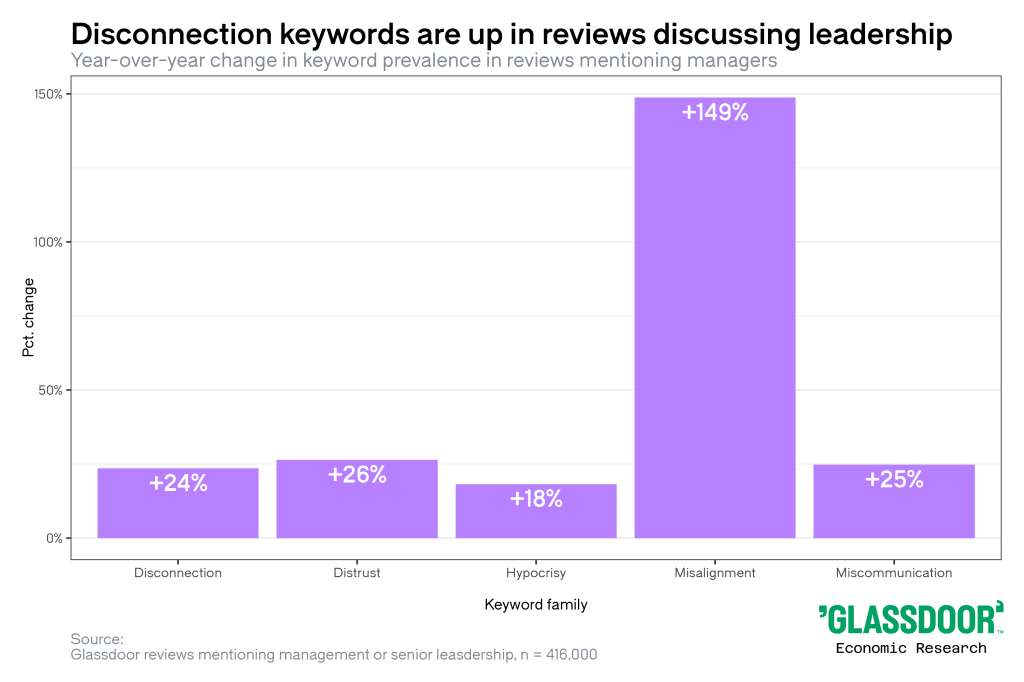
In this uneasy environment, surveys reveal a recent erosion of mutual trust between employers and employees, a rise in disengagement among workers, an increase in the frequency of layoffs, and other signals of a decline in loyalty, debasement of implied obligations, and further evidence of an increasingly transactional workplace. In reviews of senior leadership, employee ratings of their managers have dropped since 2023, and a Glassdoor survey of these reviews from late 2025 found that the words “disconnect,” “miscommunication” and “distrust” are all up by about 25% from the year before. Regarding distrust, other surveys report the same: Trust levels between the two sides are bad and getting worse.
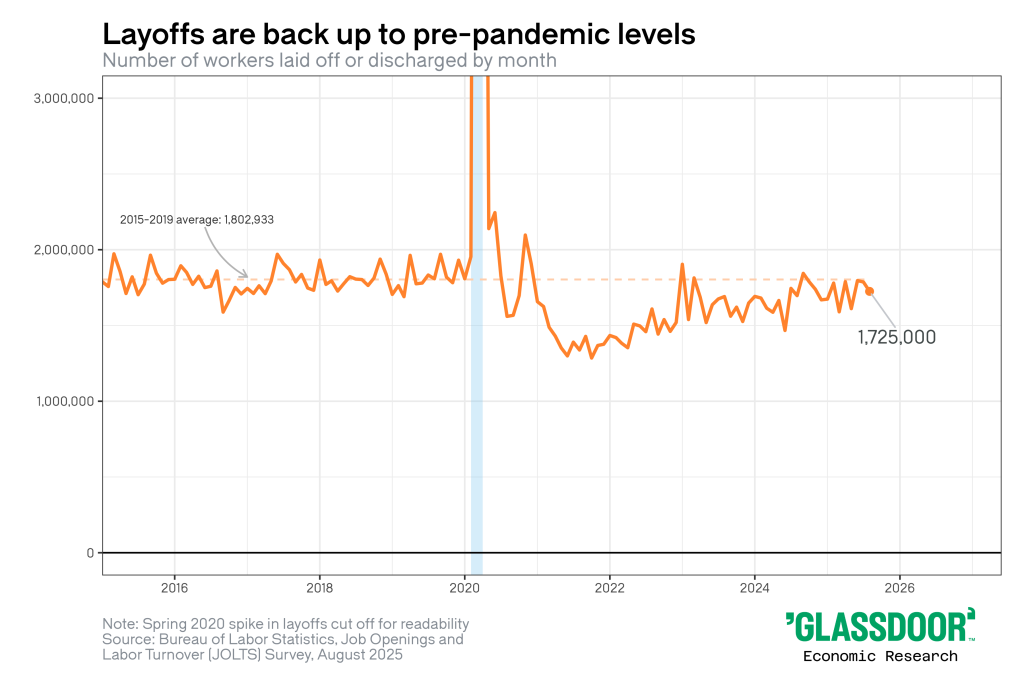
Layoffs tend to fuel employee distrust of employers, even among those who do not experience job loss.3 Over the past decade, employers have enacted small layoffs with increasing prevalence, defining a pattern of rolling job cuts — what Glassdoor has termed the “forever layoff.” Most layoffs now affect fewer than 50 workers, as firms look to reduce payroll without making headlines. The forever layoff shows no signs of ending, stoking an enduring unease among US workers. In Glassdoor reviews, the term “layoffs” is more commonly used now than when it spiked at the height of the COVID-19 pandemic, and the phrase “job insecurity” is cited at about the same rate as its pandemic-era high.
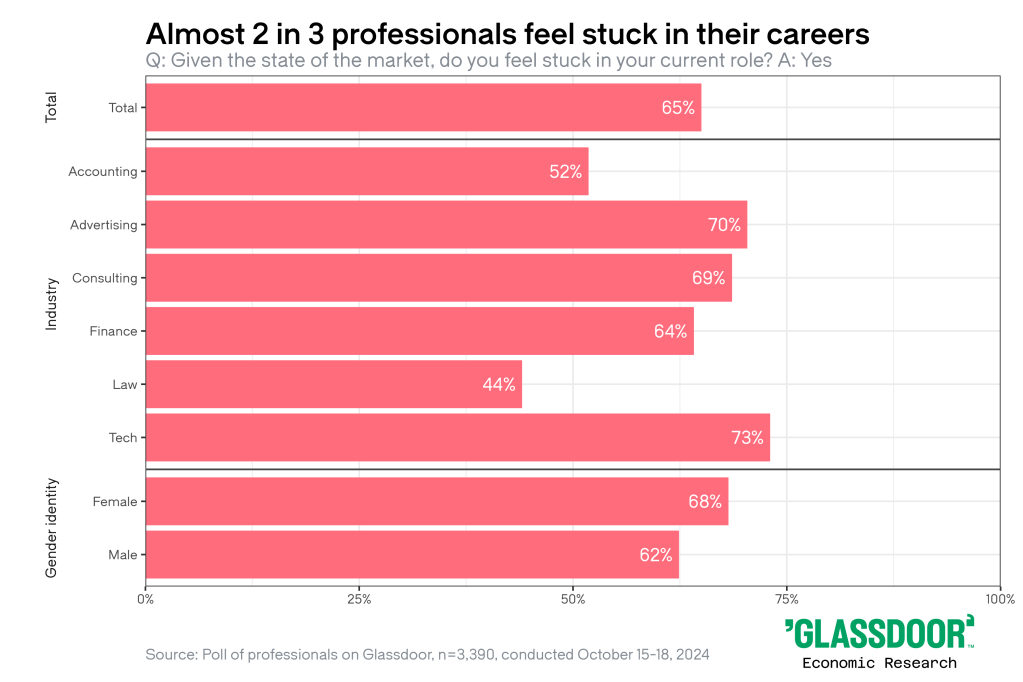
A 2024 Glassdoor poll found that nearly two-thirds of professionals reported feeling “stuck” in their current roles,4 as the quit rate among US workers fell to 1.9% as of February 2026, comparable to 2015 levels.5 Meanwhile, employee-reported satisfaction with their career opportunities has dropped in nearly every major industry since 2022. Over this same period, the share of US workers who say they are actively engaged at work has declined from a high of 36% in 2020 to 31% in 2025.6
Amid the slump in employee satisfaction and engagement, many workers report checking out on their job, a phenomenon known as “quiet quitting” or “ghost working.” In a 2025 employee survey, three out of five respondents admitted that they regularly pretend to be working to look busy, and another third said they too occasionally fake it.7 A staggering 92% of workers confessed that they have used company time to search for another job.8
These statistics seem to emphasize an utter lack of loyalty between companies and the people they employ, yet there is more to the picture than flagrant self-interest and poor attitudes. Structural factors influence worker and employer behaviors and perspectives, and these embedded dynamics offer a more nuanced explanation for what we see in surveys. Workers and firms do not operate in a vacuum but are subject to labor and financial markets, laws and regulations, cultural norms, geopolitical disruptions and extraordinary events. The COVID-19 pandemic was one of those events, a wrecking ball that impacted all the above, reshaping the world of work in lasting ways. The pandemic instigated mass worker mobility through layoffs and furloughs, voluntary job switching and the rise of remote work. Meanwhile, the pandemic prompted cultural shifts that are difficult to measure and yet persist: Now more than before, employees strive to find meaning in their work and seek flexible work arrangements. Work-life balance and self-care have become top priorities for workers as reported burnout rates have surged since the pandemic upended everything in 2020.9 10
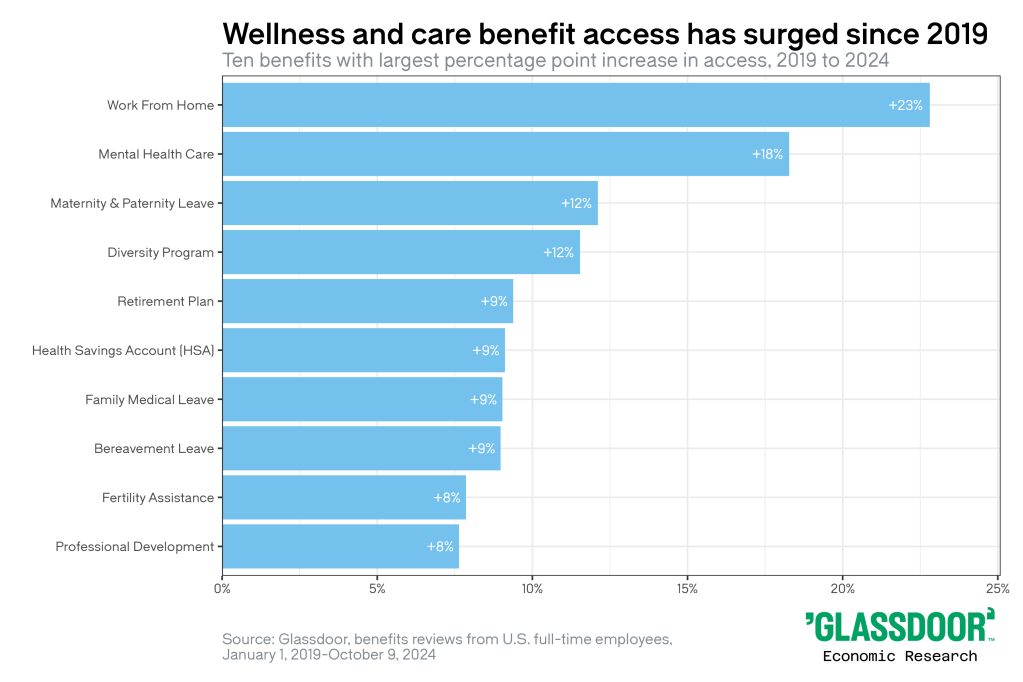
The pandemic’s compound effects created a labor market whiplash, which empowered workers to change jobs and move; to seek higher pay, more meaning and flexible arrangements from their jobs; and to prioritize their own well-being over their employers’ needs. Yet when the tide goes out, it will come back in. Worker surveys from the past two years reveal a return of employer power.11 A softening labor market and gradual return-to-office mandates have contributed to this shift, and workers’ sentiments are declining in step with their waning authority.
In this discussion about the structural elements that have eroded the employer-employee bond, we have not yet mentioned the most dominant force: money. Before workers can meet implied obligations, their contractual agreement must meet their basic needs. If the employer-employee relationship has indeed become more transactional, it may be because employees no longer see the transaction — compensation for labor — as a fair bargain.
Aside from labor market disruptions, the pandemic led to inflation, housing market distortions, and other impacts that have strained the average American’s finances. These money problems long predate the pandemic, as pay has not kept up with productivity in the US since the 1970s.12 A comprehensive 2025 assessment of American job quality found that only 40% of US workers have a “quality” job, and chief among the quality criteria is a position that meets basic financial needs.13 It is unsurprising that an employee’s self-reported satisfaction would suffer when their pay falls short. A lack of adequate pay may also explain the increasing prevalence of side gigs,14 especially among young workers: side hustles born of necessity rather than a loyalty deficiency.
Are These Changes Good or Bad?
From a firm’s perspective, being transactional is not only helpful but necessary. It is existentially important that companies focus on what they can measure, quantify and control because good vibes do not translate to cash flow, and a firm that goes belly-up does a disservice to its employees and shareholders. Building a strong organizational structure inherently means leaning into a workplace’s transactional features, including explicit benchmarks and planning. A firm’s transactional qualities promote all kinds of efficiencies, allowing organizations to operate with speed and agility and to restructure when necessary.
Being transactional also helps firms maintain a healthy employer-employee relationship, as putting things in writing clarifies performance goals and expectations. This transparency reduces the potential for internal conflict while promoting accountability. When an employer is clear and upfront about company policies, it tends to boost employee morale because workers feel that everyone is operating by the same rules.
Among the potential downsides, high turnover is a hallmark of a highly transactional workplace, and while there are many reasons good and bad for employee exits, too much turnover is harmful to firms. When a worker leaves a job, whether voluntarily or not, they take skills and job-specific knowledge with them. The drain of expertise weakens team cohesion while creating development gaps in a firm’s leadership pipeline. Leadership gaps become persistent, as talent does not spring forth organically from the earth — its development requires substantial investments of capital, time and labor. Hiring and retention problems worsen when workers perceive a firm as overly transactional. If an employer were to lay off employees without warning, for instance, its reputation would take a hit among those who were let go as well as those who remain, and these reputational downgrades endure for years.
The Hidden Costs of Job Insecurity
“Workers today favor a workplace culture in line with their own values,” says Daniel Zhao, referencing analysis of Glassdoor reviews.”
Workers seek security and transparency from their employers, and they especially do not want to feel like they could be laid off at any moment without warning or cause. When employees feel job insecurity, they are less likely to do work beyond their formal job requirements. Information and knowledge industry workers in particular need some degree of autonomy to be productive and innovative. This freedom affords employees the cognitive space to come up with novel ideas and explore avenues that are not stipulated by any contract or explicit request from a superior.15
In the modern workplace, where most workers are part of a team or network of employees, innovation requires coordination. A firm or a workforce that is overly transactional would have difficulties achieving the organizational harmonization needed to unlock its innovative capacities. When employers and employees are solely focused on the singular roles, hours worked or work products specified in a formal job description, cross-functional synergies are missed like the forest for the trees.
Myriad benefits accrue to employers and employees who find the right balance of transactional duties and implied obligations, creating an environment that we refer to as a workplace’s culture. The enduring concept of office culture speaks to the fact that work today remains centered on people, despite perennial fears of automation. Even with the rise of artificial intelligence, human intelligence is still prized, and human labor is the engine of productivity. “Humans are social creatures,” Zhao reminds us. “People want to work with others they like. Employees expect the same from their employer as they do from their other relationships.”
What the Rise of Hybrid and Remote Work Has Changed
It may feel disingenuous when an employer espouses a familial workplace ethos and then enacts a transactional culture. This misalignment between what employers champion as their culture and what employees experience increasingly shows up in Glassdoor reviews, a sign that firms have not yet found the optimal equilibrium between the transactional and implicit.
Part of the misalignment problem may stem from the rise of hybrid and remote work, which proliferated during the COVID-19 pandemic. To some degree, these types of flexible work arrangements are here to stay, as a large share of workers prefer to have a say in their schedule and location where they work.16 Yet remote work has downsides, as it inhibits the human connection that is needed for innovation, skill development, knowledge-sharing, career advancement and, in many cases, enjoyment of work.17 Lack of in-person interaction may also erode trust among co-workers and between employees and managers. A growing number of employers have instituted return-to-office mandates in the past two years, and many workers are voluntarily returning to work in person in hopes of recognition and promotion. Yet RTO mandates, which are meant as a transactional agreement, are often difficult to enforce, proving in some cases to be a psychological contract held only by the employer.
Finding Equilibrium
We are still living and working in the wake of the COVID-19 pandemic. Yet, despite the pandemic’s lasting disruptions, the employer-employee relationship and their expectations are not so different from a generation ago. “Workers today want the same core things from their employer as workers of earlier generations wanted,” Zhao points out. “They want a healthy culture, opportunities for career advancement, and leaders that give them confidence.”
What does it take to realize this optimal balance of transactional obligations and compassionate culture-building? It starts with clear communication — not just about policies and expectations, but also about the human dimensions of work that contracts cannot capture. It also requires firms to make that implied bargain visible by setting transparent criteria for promotion, giving workers a credible sense of how advancement happens, and handling layoffs or restructurings with a degree of candor and fairness that employees can recognize. That task has grown more challenging with the spread of remote and hybrid arrangements, as it is genuinely difficult to sustain a workplace culture through email and video calls alone.
Workers have not stopped wanting what they have always wanted: fair compensation, genuine opportunity and an employer who treats them as people, not just payroll. Firms have not abandoned the idea of culture; if anything, they speak about it more than ever. The problem is the gap between what employers say and what employees experience, and that gap shows up in Glassdoor reviews, in disengagement surveys, and in the quiet exodus of workers who are physically present but mentally checked out.
Closing that gap does not call for reinventing the employment relationship, but it requires firms to honor the implied bargain that has traditionally accompanied the formal one. This unwritten pact is founded in the understanding that loyalty, when sincerely exchanged by both sides, is not a weakness but a competitive advantage. Employers who adeptly navigate today’s crosscurrents will not be those that perfect the transaction by, say, offering the biggest bonuses. The firms that succeed in the long run are those who grow a corporate culture promoting the productive capacities of their workforce while valuing their employees’ basic humanity.
The Kenan Institute’s annual Grand Challenge is a yearlong initiative focused on a vital issue facing business and society. The 2026 Grand Challenge explores what happens as employers and workers redefine how work fits their needs. Daniel Zhao is part of the 2026 class of Kenan Institute Distinguished Fellows.
1Rousseau, D.M. Psychological and implied contracts in organizations. Employ Respons Rights J 2, 121–139 (1989). https://doi.org/10.1007/BF01384942
2 U.S. Bureau of Labor Statistics. Women in the Labor Force. https://www.bls.gov/cps/demographics/women-labor-force.htm
3 Martin, C. (September 16, 2025). Layoffs Cast a Long Shadow. Glassdoor. https://www.glassdoor.com/blog/layoffs-cast-a-long-shadow/
4 Zhao, D. (November 19, 2024). Glassdoor Worklife Trends 2025. Glassdoor. https://www.glassdoor.com/blog/worklife-trends-2025/#Trend1
5U.S. Bureau of Labor Statistics. (March 31, 2026). Quit levels and rates by industry and region. https://www.bls.gov/news.release/jolts.t04.htm
6 Harter, J. (January 28, 2026). U.S. Employee Engagement Declines From 2020 Peak. Gallup.https://www.gallup.com/workplace/701486/employee-engagement-declines-2020-peak.aspx
7 Spencer, K. (May 17, 2025). Ghostworking: 58% Admit They’re Pretending to Work on a Regular Basis. Resume Now. https://www.resume-now.com/job-resources/careers/ghostworking-report
8 Castrillon, C. (June 11, 2025). Job Hunting During Work Hours? Here’s Why ‘Ghostworking’ Is Surging.Forbes. https://www.forbes.com/sites/carolinecastrillon/2025/06/09/the-ghostworking-boom-92-of-workers-job-hunt-on-company-time/
9 Burleigh, E. (November 17, 2025). Work-life balance finally outranks pay as a top motivator for job seekers, but CEOs aren’t sold. Fortune. https://fortune.com/2025/11/17/work-life-balance-outranked-pay-top-perk-peoeple-choosing-a-job/
10 Zhao, D. (April 29, 2025). Burnout is on the rise. Glassdoor. https://www.glassdoor.com/blog/burnout-rising-2025/
11 Edwards, K. A. (January 21, 2025). The American Worker Has Lost All Leverage. Bloomberg. https://www.bloomberg.com/opinion/articles/2025-01-21/the-american-worker-has-lost-all-leverage-in-job-market?embedded-checkout=true
12 Economic Policy Institute. (March 23, 2025). The Productivity-Pay Gap. [https://www.epi.org/productivity-pay-gap/
13 Gallup, Inc. (2026). The American Job Quality Study: 2025 State of the U.S. Labor Force. Gallup. https://www.jff.org/wp-content/uploads/2025/10/AmericanJobQualityReport_Final_10142025.pdf
14 Zhao, D. (November 19, 2024). Glassdoor Worklife Trends 2025. Glassdoor.https://www.glassdoor.com/blog/worklife-trends-2025/#Trend1
15 Davis, P. (February 17, 2025). Why Employees Need Autonomy. Knowledge at Wharton. https://knowledge.wharton.upenn.edu/article/why-employees-need-autonomy/
16 Pendell, R. (September 15, 2023). More Employees Want a 9-to-5 Schedule Than Leaders Think. Gallup. https://www.gallup.com/workplace/510656/employees-schedule-leaders-think.aspx
17 Kuhnen, C. & Rosengarten, C. (January 21, 2026). Renegotiating Work: Balancing Workplace Demands in Uncertain Times. Kenan Institute of Private Enterprise. https://kenaninstitute.unc.edu/kenan-insight/renegotiating-work-balancing-workplace-demands-in-uncertain-times/