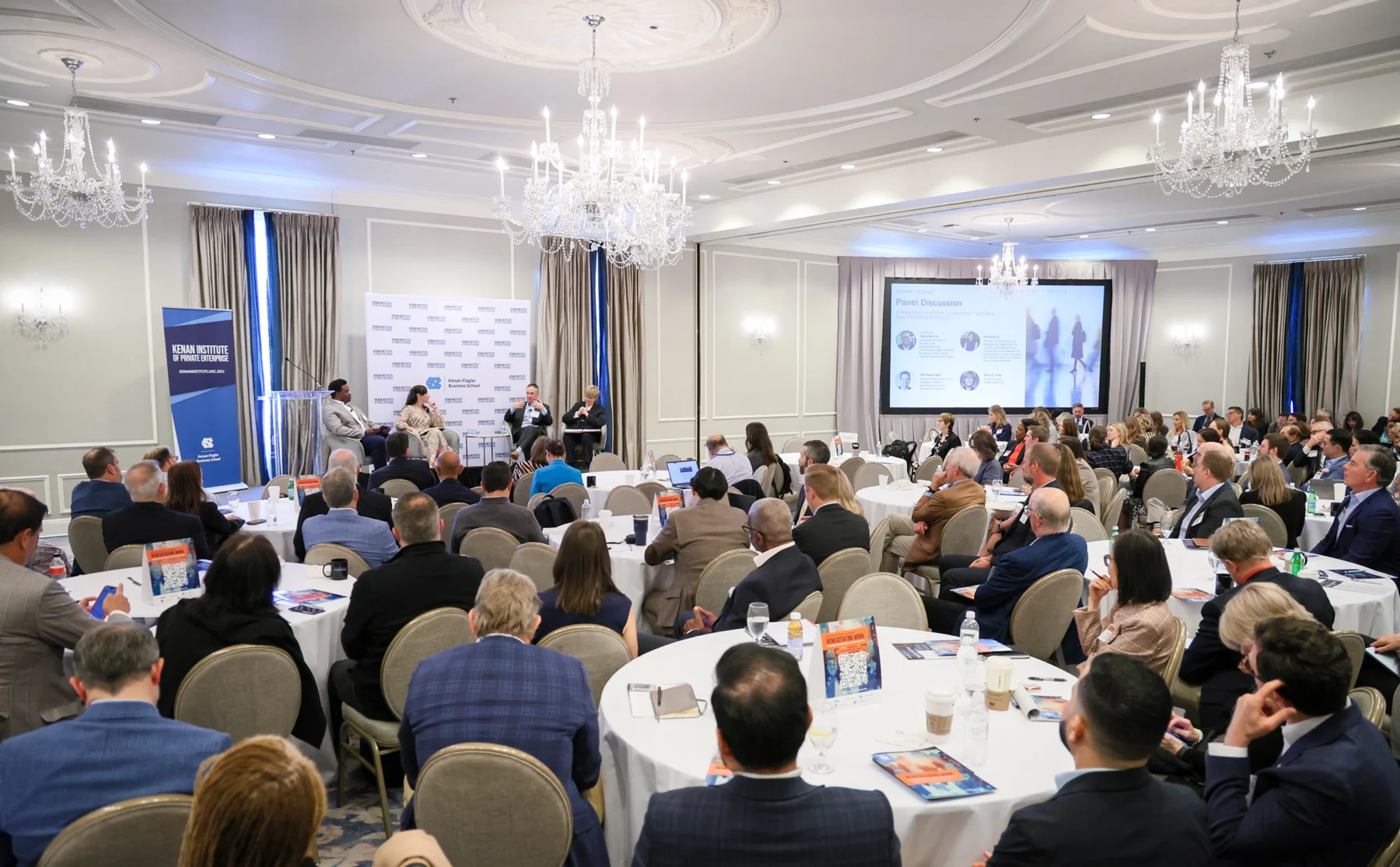



“The nature of work is shifting, and it’s shifting in ways that feel qualitatively different from changes that have come before,” observed Paige Ouimet, executive director of the Kenan Institute of Private Enterprise and UNC Kenan-Flagler Business School finance professor, as she opened this year’s Frontiers of Business Conference on October 8.
Culminating the institute’s 2026 Grand Challenge on “Renegotiating Work: Balancing Workplace Demands in Uncertain Times,” Frontiers brought together leaders from business, government and academia to explore and discuss pressing questions on work, leadership, flexibility, talent and technology. Threading through the day’s presentations and conversations, five themes stood out, highlighting enduring insights and solutions to today’s business challenges.
We Are at an Inflection Point
From UNC Chancellor Lee H. Roberts’ opening remarks to the three interactive roundtables that made up the day’s final session, Frontiers participants affirmed that our present moment marks an inflection point for the economy and the nature of work. Conference speakers and attendees referenced economic uncertainty, rapid technological change and geopolitical risk as chief among the global forces that lent the day’s discussions a resolute urgency.
This mix of challenges creates distinct challenges for everyone — from C-suite executives to entry-level workers, policymakers to their constituents, and university administrators to their students. Frontiers brought together experts, practitioners and representatives from these societal sectors to share data-driven evidence and powerful anecdotes on the wide range of issues they have encountered and the solutions deployed.
Business leaders spoke earnestly about the imperative to employ workers with broad, adaptable skill sets fit for the highly dynamic, changeable environment that characterizes contemporary work. Meanwhile, it is evident that workers increasingly pursue occupations that offer growth opportunities, flexibility and a mission aligned with their own values. These trends pressure educational institutions, especially public universities such as ours, to build partnerships with business and civic groups with the aligned goals of driving innovation, economic growth, human development and a broadly shared prosperity.
How to prioritize and implement the strategies to achieve these objectives is continuously negotiated. There is no time like the present for these solutions to be developed because, as the Frontiers conversations made clear, we are at an inflection point.
There Is Strength in Cross-Disciplinary Collaboration
Frontiers brings people from different walks of life together to share their distinct perspectives, experiences, and research. This sort of cross-disciplinary convening is vitally important for developing workable solutions to the very issues that conference speakers and attendees were there to discuss. The day’s conversations revealed that the business problems of today extend across society. These complex challenges demand multidimensional solutions, approaches fashioned from many disciplines.
To this end, the conference was a petri dish nurturing productive thought and critical discussion, bringing midcareer executives and business leaders together with young professionals, researchers, educators, policymakers and other mission-driven actors. The day’s events provided many opportunities for attendees to speak and be heard, to share experience-based learning and formulate novel approaches to tackle pressing issues, such as building durable talent pipelines and promoting workforce participation.
Bridging Generational Divides Is a Business Imperative
The day’s expert presentations, question-and-answer sessions and roundtable discussions provided platforms for conference attendees to workshop business solutions. These approaches are generally designed to bridge gaps, from skills gaps and capital shortfalls to informational mismatches and differences in perspective. Speaking to our pivotal moment, solution-seekers aim to connect the present to an improved and more prosperous future.
Succeeding in this mission requires that we bring together generations, aligning the success of all cohorts, from those aging out of the workforce to workers in mid- and early careers as well as students and young people who will soon begin their professional lives.
At Frontiers, researchers presented data-backed evidence on the shifting perspectives on work from one generation to the next. In many ways, young workers are not so dissimilar from older generations in their wants and needs, yet the realities of the world have changed. In a business environment where technological advancements regularly upend the way we work and the labor market is in a fixed “low-hire, low-fire” state, young cohorts report considerable unease about their prospects for professional growth. Few expect smooth sailing ahead.
As the “silver tsunami” washes ashore, business leaders must act decisively to safeguard firm-level succession and knowledge retention. Maintaining intergenerational cohesion means investing heartily in talent development and human capital. Business leaders hoping that machines fill the generational void risk their companies’ future, as human judgment and high-order skills are needed, now more than ever, to spur innovation and maximize productivity.
Culture and Leadership Remain Competitive Advantages
Many conference attendees pointed out that, despite the business world’s tendency to focus on strategy, a firm’s culture remains crucially important to its success. Research shows that employees today want their job to be flexible yet secure, to offer a work-life balance, fulfilling tasks and a mission that aligns with their values. Modern firms’ expectations of their workers are similarly extensive, as companies need employees that prioritize the firm’s goals and mission, bringing broad skill sets and growth mindsets to the job. Connecting these groups, a company’s culture is the glue that bonds corporate components, building a whole sturdier than its parts.
Developing a durable culture requires effective leadership, which is especially vital in our current moment, one defined by an increasingly uneasy relationship between workers and employers and a growing distrust in institutions. And yet, practicing effective leadership is more challenging than ever, in large part because of the extreme complexities, heightened uncertainties and rapid change that characterize today’s business and geopolitical environment.
While many business heads seek technocratic solutions, data-based management is necessary but not sufficient to build a robust company culture. Effective leaders must be dynamic, resilient and adaptable, leveraging high-order capabilities to align worker goals with a firm’s success.
The Machines Have Arrived, Yet the Future Is Human
For centuries, workers have worried that machines would make them redundant, and, now more than ever, this fear is top of mind for them. Advances in computing have created a new class of technologies known as artificial intelligence that have stoked these long-held anxieties.
Frontiers’ speakers and attendees expressed cautious optimism about AI’s effects on work, as technological advancements tend to augment work, creating more jobs and more wealth than they destroy. The wider discourse around AI shows a tendency to the extremes — AI will either usher in a utopia of infinite abundance or it will make human labor obsolete and lead to civilizational collapse — but the conference eschewed these extremes.
The day’s discussions on AI were based on real-world observations and offered constructive, expert opinions on what these new technologies mean for the nature of work in the near and medium term. AI will affect every sector, though unevenly, and special attention needs to be given to the professions most exposed to its destructive effects.
By empowering machines with greater cognitive functions, we may raise the floor for human workers, as anyone with a computer can now create “good enough” cognitive products. These actions would also enhance the value of the voice, judgment and lived experience of people, giving added worth to workers who can express ideas with greater insight and implement workflows with better results than even the most powerful computers.
The gloom and doom of AI should be reserved for the oversized capital investments it is now commanding. These massive expenditures going to a narrow slice of technologies are crowding out other worthwhile investments. Economists and sober-minded technologists can agree that, while AI shows great innovation-unlocking promise, to remain a vibrant society, we must boost investment in the training, education and well-being of the nation’s human capital.
The day’s conversations made clear that, while the nature of work is changing, work will continue and human labor will be valuable for the foreseeable future. Organizations that invest in people and leverage collaboration to adapt to change will be positioned for success. This strategy holds true for all kinds of institutions, from private firms to public universities.
As Roberts, UNC’s chancellor, reminded attendees, “We want to build closer, tighter, more effective relationships with the private sector because we believe that it’s part of fulfilling our mission of service to the state of North Carolina. And if we’re able to adapt effectively to this rapidly changing environment, then the best days for our state and, consequently, for our university will always lie ahead.”