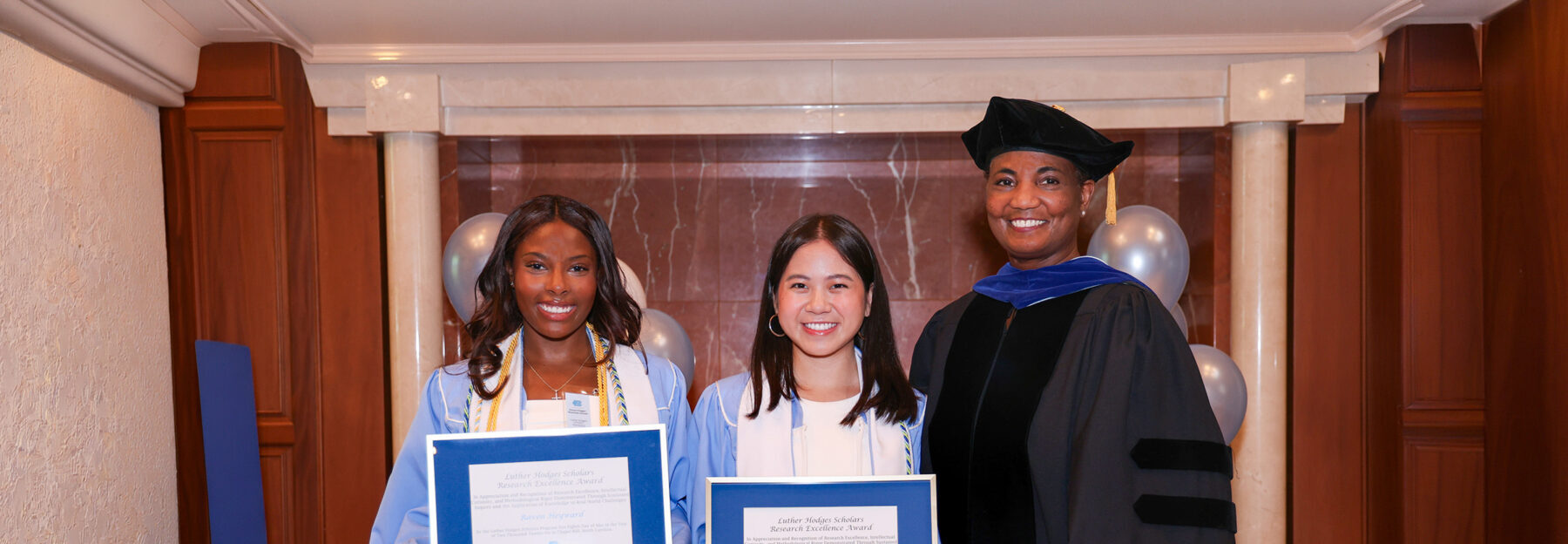


Luther Hodges Scholars Raven Heyward (left) and Chi Vu (center) and program Executive Director Kim Allen at the Class of 2026 Luther Hodges Scholars Graduation Ceremony.
The world’s toughest economic and societal challenges rarely fit neatly within a single discipline or sector. They demand business leaders who understand markets, ask difficult questions, use evidence to inform decisions and know when collaboration across sectors is essential.
The Luther Hodges Scholars program, a partnership between the Kenan Institute of Private Enterprise and UNC Kenan-Flagler Business School, was created 10 years ago with that vision for leadership. Its mission is to develop cross-sector business leaders who understand how markets create prosperity, recognize where collaboration across business, government and the nonprofit sector is necessary, and are equipped to address complex societal challenges through principled leadership, rigorous inquiry and business excellence.
Each year, about 25 UNC Kenan-Flagler Business School sophomores enter the 2.5-year program. And each year, a few seniors elect to lead a yearlong honors thesis, a rigorous research project that elevates their scholars experience.
Students identify a question they are deeply passionate about, conduct original research and learn to navigate the ambiguity that often accompanies complex problems. Along the way, they develop transferable skills that extend beyond research.
Curiosity, Research and Real-World Impact
That spirit of inquiry is evident in the work of scholars like Raven Heyward, one of six among the Class of 2026 who completed a senior thesis.
Heyward’s thesis examines how organizational structures and governance shape inequities in hiring technologies. “Over 55% of large US employers are using automated screening tools, which means that algorithms can reject you before any human ever sees your materials,”Heyward explained. “I really wanted to understand how inequities are built into the systems and how we can go in and change them.”
For some scholars, the honors thesis process means tackling questions that affect millions of workers every day. What’s the impact of leadership ethics on employee well-being? Moreover, how does an employer’s ethics affect an employee’s mental and physical health? Adhithi Ramprakash posed these questions to a group of 300-plus full-time employees.
According to Ramprakash, her data shows that leadership that is “unethical” is correlated to a decrease in an “employee’s internal energy, which caused them to have higher levels of depression, somatic complaints and work withdrawal.”
As Ramprakash explained, “A person who’s not in the right mental space to be doing the work that they’re doing is not going to perform as well,” underscoring the role leadership ethics plays in fostering environments where both employees and organizations thrive.
Chi Vu wanted to understand how conservation and economic development can work together by examining integrated mangrove shrimp farming systems in Vietnam.
While these systems are often seen as win-win for the environment and rural livelihoods, Vu said she identified a critical gap: “There was very little research on the short-term financial costs that farmers face when transitioning from traditional farming systems.” By investigating this overlooked challenge, Vu’s work helps identify pathways to conservation that are both environmentally and economically sustainable.
For Vu, the project brought her full circle. Returning to southern Vietnam as a senior researcher after helping plant mangroves there as a first-year business administration student “gave me the opportunity to contribute to such a meaningful topic that is highly relevant to the future of Vietnam’s coastal communities,”she said.
Whether examining sustainability efforts, market behavior or other real-world challenges, Luther Hodges Scholars are united in their desire to better understand how people make decisions. “I’ve always loved art history and discovered there’s an entire art market where art and business converge,” said Kathryn Bolick, whose thesis examines how pricing influences outcomes in the fine art market.
“I found the interconnection and organizational behavior concepts in play here really interesting to dive into. There’s so much interplay between the art auctioneer, the seller and the bidder,” Bolick noted. She found evidence of anchoring — a psychological tendency to rely on initial information when making decisions — that, while observed in multimillion-dollar art auctions, can be leveraged across industries and professional skill sets, including negotiation, pricing strategy and consumer behavior.
Other scholars tackled equally complex questions. Lucia Park explored statistical methods that help researchers make more accurate comparisons across groups when evaluating medical treatments and public health outcomes. Meilin Weathington looked at how Colonial history continues to shape US foreign policy and economic sanctions, offering new insight into the historical forces that influence global politics and international relations.
The process culminates in the Spring Research Fair, which took place in April. Celebrating the scholarly contributions of graduating seniors, the fair features a poster gallery walk highlighting honors thesis projects, a moderated panel with student researchers plus an opportunity for underclassmen to discover the role research can play in their scholars experience.
A Lasting Investment in Future Leaders
For students considering tackling a senior thesis, Ramprakash encourages choosing a topic driven by curiosity rather than credentials. “Be inspired by your topic. Don’t just do it because it’s another thing to add to your resume,” she advised. Read more thesis advice here.
Students who complete the project gain skills that transfer to the boardroom and well beyond. And the shift happens in real time. Students learn how to conduct independent research, expand their professional networks, think critically, solve complex problems and persevere in the face of ambiguity.
“There were so many moments where I had to navigate uncertainty and solve problems without clear answers, but I realized that when I’m deeply invested in a subject, I’m willing to put the time and effort needed to overcome these challenges,” said Vu.
Kim Allen, executive director of the Luther Hodges Scholars program, said the honors thesis represents a different kind of learning from what students typically encounter in the classroom.
“Much of higher education is about learning what others have already discovered,” Allen said. “Research invites students to ask their own questions, follow evidence wherever it leads and contribute new understanding. In the process, they develop habits of inquiry that will serve them throughout their careers.”
She said the honors thesis reflects the program’s broader mission of developing cross-sector business leaders prepared to navigate complexity with curiosity, evidence and sound judgment.
“Students don’t simply graduate with a completed thesis,” Allen said. “They leave better prepared to ask difficult questions, evaluate evidence, navigate complexity and exercise the judgment that effective business leaders need in an increasingly interconnected world.”
Rising sophomores applying to UNC Kenan-Flagler Business School as a business administration major or minor are eligible to apply to become a Luther Hodges Scholar. The application process begins in early summer each year. Learn more about the program and application process today.