


- North Carolina’s rapid economic growth is creating unprecedented demand for skilled workers, widening the gap between industry needs and available talent.
- Apprenticeships and innovative training models deliver proven returns for workers and employers but face barriers of funding and coordination.
- Business and education leaders agree that clearer goals, better data and sustained investment are key to unlocking the state’s powerful workforce potential.
Marked by transformation, the 21st century economy’s continuous technological innovation, demographic changes and cultural shifts are upending how people work. As skills in demand change faster than the workforce can supply them, the gap widens between the skills businesses need and those workers have. North Carolina’s growing skills gap reflects the national challenge, but there is cause for optimism here: The state’s robust job market is creating opportunities in advanced, high-paying fields. We are home to an array of businesses eager to hire skilled workers among growing communities that attract people from all over the country.
The challenge: How do we equip our workforce with the skills that industries demand? The short answer is workforce development. Yet implementation is anything but simple.
In June 2025, the North Carolina Governor’s Council on Workforce and Apprenticeships formalized 11 goals to enhance and expand workforce development. Benchmarks include 2 million North Carolinians holding an “industry-valued credential or degree” (Goal 1) and 50,000 employer partners (Goal 6), along with strategic goals, such as workforce plans for advanced manufacturing, healthcare and education (Goal 8). These aims reflect the state government’s commitment to bridging the skills gap 1 as well as the consensus belief that strengthening North Carolina’s workforce system is central to meeting demand. The “how” is the tricky part.
With more than 500 training programs – run by community colleges, governments, private firms and nonprofits – North Carolina’s initiatives are as diverse as its geography and people.2 Most worker training programs engage relatively small cohorts and are tailored to community or employer needs. They show impressive results in credentialing and job placement but are difficult to scale. Some barriers result from local characteristics. A rural nonprofit in Western North Carolina will have distinct needs compared with one serving Charlotte, for example.
Budgetary barriers compound the challenge – not only a lack of funds, but a lack of stability. Training requires long-term investment of time and resources from employers, trainees and the organizations that connect them. Sustained commitments of financial and human capital are essential to meet shifting industry demands.
As challenging as it is to secure these inputs – adequate funding and human expertise – educators must also guarantee “products”: a credential, a verifiable skill set and a career path. Yet a patchwork of credentialing standards and weak data infrastructure complicate skill development and job matching. These issues are not unique to North Carolina – they mirror national trends. Effective solutions in our state could inform solutions on a wider scale.
Voices of Leadership
To better understand the landscape, we leveraged the expertise of four key stakeholders:
- Chris Harrington, director of ApprenticeshipNC, North Carolina’s state apprenticeship agency housed in the community college system.
- Monique Perry-Graves, CEO of Road to Hire.
- Meredith Archie, senior vice president of external affairs for the NC Chamber and president of the NC Chamber Foundation (also a Kenan Institute of Private Enterprise Board of Advisors member).
- Vincent Ginski, NC Chamber Foundation’s director of workforce competitiveness.
Chris Harrington on the ‘Registered Apprenticeship’ Model
An impassioned advocate for apprenticeship, Chris Harrington became director of ApprenticeshipNC in January 2024 after a 40-year career in industry and academia. “I got involved in apprenticeship as an employer to solve a problem,” he recalls. “A skills gap problem.”
“When I’m talking about apprenticeship, I’m talking about registered apprenticeship,” Harrington says, and ApprenticeshipNC is the governing body for apprenticeships in the state.
Adhering to federally mandated standards, registered apprenticeships have the built-in advantage of offering a transferable credential. Sheet metal apprentices training in High Point could use their earned credentials to work anywhere in the country. Standardization also includes a baseline of skills that trainees and employers can count on as part of credentialing, met through rigorous training criteria and benchmarks.
“The minimum time for a registered apprenticeship is 2,000 hours, which is essentially a year of on-the-job learning,” Harrington says. “And for every year of on-the-job learning, there must be at least 144 hours of what we refer to as ‘related instruction’ – think classroom theory to augment that on-the-job learning.” While Harrington concedes that apprenticeship is not the best training route for every position, it is the best path for jobs that require more than nine months to master and do not require a four-year degree. This describes more than half of jobs today.
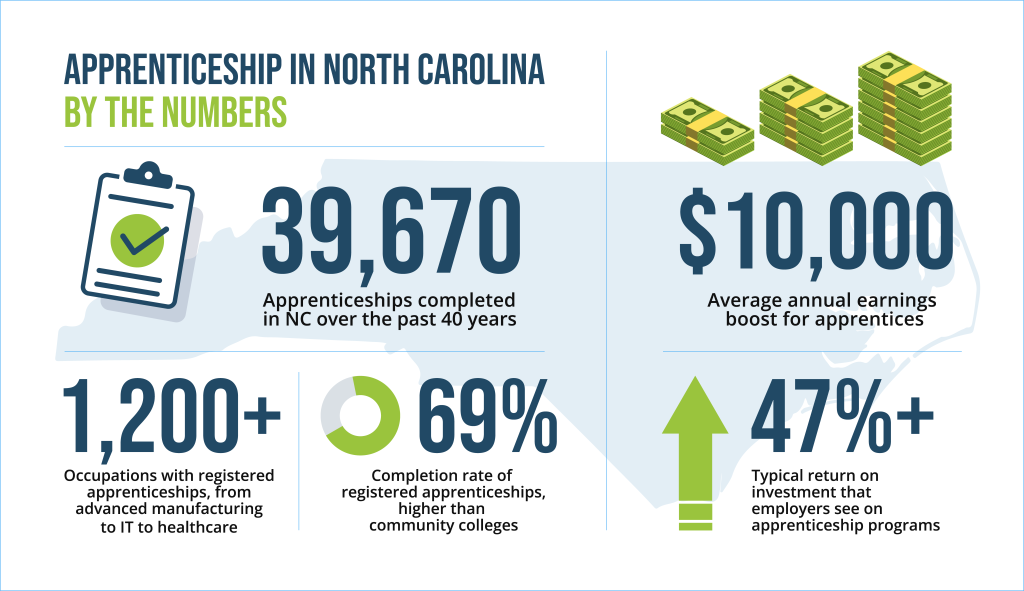
“There are over 1,200 occupations that have been deemed ‘apprentice-able,’” Harrington says, a broad range that includes trades, IT, healthcare and teaching.
North Carolina’s Many Apprenticeship Models
Registered apprenticeship serves diverse groups, not only high schoolers. For military veterans, justice-involved individuals, people entering the workforce from nontraditional roles (think stay-at-home moms) and many others, apprenticeship offers an established path to high-earning careers. Organizing across this spectrum requires multiple models:
- Traditional model: A single employer registers an apprenticeship program.
- Group Sponsor model: An intermediary, often a community college or nonprofit, establishes the program with participating employers, reducing the burden for the employers.
- Consortia model: K–12 schools, community colleges and employers collaborate in a local ecosystem to create an integrated pathway to and through apprenticeship.
“We’ve got 120,000 high school graduates average every year in North Carolina on average. It’s a natural talent fund,” Harrington emphasizes.
ApprenticeshipNC serves four key roles: program registration, quality assurance and governance, technical assistance, and promotion and advocacy. “ApprenticeshipNC primarily works with sponsors and employers – we are market makers,” Harrington says. “Because if there are too many employers and not enough apprentices, then we’ll lose employers, or if there are too many apprentices and not enough employers, then we will lose interest. So, we do have to try to do both.”
Source: ApprenticeshipNC 2024-2025 Annual Report
Apprenticeship Boosts ROI for Apprentices, Employers and the State
Demand for apprenticeship is surging. ApprenticeshipNC reports that apprenticeship and preapprenticeship enrollment more than doubled between 2020 and 2025. In fiscal 2024, the agency added more than 100 new apprenticeship and preapprenticeship programs, engaging about 350 new employer partners, and nearly 7,000 new enrollees. And for these stakeholders, the financial returns are strong.
“The average apprentice makes $10,000 more than their peer in the same occupation, and that persists over their lifetime,” Harrington says. “So that’s $400,000 in lifetime earnings. And depending on the industry, most employers see an ROI of 50% or more.” By one estimate, North Carolina’s nearly 40,000 completed apprenticeships over the past 40 years have generated $48 million a year in additional state tax revenue.
Despite the excellent return on investment, funding for apprenticeships is fragile. NC Department of Labor grants to expand their reach in recent years expire next June. “We’ve got a short runway,” Harrington says. “We need to have appropriate operating funds, without which we lose most of our team and our ability to serve as a growth catalyst is hampered.” Harrington points out North Carolina would also benefit from sustained employer incentives. States like South Carolina offer a $1,500 tax credit to businesses for every apprentice they onboard. “That’s pretty powerful,” Harrington admits. “I come from business, so I know that our tax code favors capital investment. If I’m investing in property, plants, equipment or technology, I get favorable tax treatment. If I’m invested in human capital, I get nothing.”
On-the-Ground Innovation: Monique Perry-Graves and Road to Hire
Road to Hire is a Charlotte nonprofit that empowers students to attain skills, excel through college and thrive in high-paying careers. “We’re not ‘Road to Graduate’; we’re Road to Hire,” says CEO Monique Perry-Graves. “The mission is only fulfilled once they have a job.” R2H functions like an “intermediary” in the group program apprenticeship model Chris Harrington described, yet R2H operates outside of registered apprenticeship, helping students prepare for jobs that require four-year degrees.
Starting in high school, R2H teaches students career-oriented technical skills for class credit. Some of these students are then eligible for R2H’s scholarship program, covering four years of tuition in high-demand majors like business, science and technology. “During that time,” Perry-Graves says, “we provide them with a student coach who meets with them on a biweekly basis to ensure their persistence and retention.” R2H also helps its students with paid internships in the summer, in which students report to a manager, gain important skills and begin their professional careers before they even graduate.
“Currently, we’re serving over 1,700 students,” Perry-Graves notes. “We gave away over $4 million in scholarships last year, and our goal is to be with students in an uninterrupted fashion for six to seven years, until they get a job.”
A steadfast presence in their students’ crucial learning years, R2H’s comprehensive approach to professional empowerment is also flexible and formed to fit individual needs. Its program helps high schoolers with college planning, career planning, academic advising and tutoring. In making connections with employers and academic institutions, R2H positions its students among a network of mentors, teachers, job trainers, advisers and peers that help guide individuals through the paths best suited to their interests, abilities and ambitions.
Since R2H focuses on placing its students and trainees in high-paying careers, the ROI for these individuals is exceptionally high, and demand for R2H’s services is booming. The challenge to scale, ironically, is scale itself. R2H must match every graduate with a quality job opening because, as Perry-Graves reminds us, merely preparing students for careers does not fulfill its mission. “We won’t be satisfied,” she says, “until a high-paying career is in place.”
R2H partners with 70% of Charlotte’s Fortune 500 companies, but scaling dozens of individuals to hundreds per cohort requires more resources for curriculum development, job matching and broadened coordination efforts. “Our company partners love our program,” Perry-Graves says. “Our success is a matter of making sure our curriculum, our work and our students’ readiness is where it needs to be, especially as jobs and needed skill sets are rapidly advancing.”
R2H’s intensive, personalized model is ripe for replication. Yet the characteristics that distinguish its program – comprehensive support systems that start early and continue through a high-earning job placement – can make it more challenging for others to scale and emulate without the private-public partnership orientation that R2H has. Its continued success shows that consistent resources and upskilling opportunities can empower underserved youth to thrive.
The Employer and Policy View: Meredith Archie and Vincent Ginski from the NC Chamber
Meredith Archie, senior vice president of external affairs and NC Chamber Foundation president, and Vincent Ginski, NC Chamber Foundation director of workforce competitiveness, bring the employer and policy perspective. With workforce consistently ranked as the top concern in the chamber’s annual CEO poll, they focus on strengthening connections between North Carolina employers and talent – an area they see as ripe for improvement.
“Scaling is the big challenge,” Ginski says. “Our system is not built to scale.” He points to nursing as an example: North Carolina needs 7,000 new registered nurses each year but produces only 4,600. Even when educators want to expand training programs, their ability to grow is limited by fragile connections. “If one work-based learning site is no longer available, it throws a wrench into all other programs’ ability to grow,” he says.
For Ginski, the central challenge is the absence of clear targets. “If we’re not willing to set workforce goals with confidence, it’s really hard to allocate resources in an optimal way.” Archie agrees, noting that progress depends on employers and educators forecasting together.
Both leaders stress that scaling requires more than enthusiasm. Archie emphasizes durable systems – “coordination infrastructure, data infrastructure and goal-setting infrastructure” – that align with what she calls “thoughtful and strategic” policy. Ginski complements this view from a pragmatic angle: Without clear targets and usable tools, scaling is impossible. He points to the need for new products that can help translate job postings into skill sets, forecast labor demand, and align education pipelines with business needs as practical tools to support scaling.
When it comes to funding, both Archie and Ginski emphasize flexibility over one-size-fits-all formulas. They highlight the variety of options already tested in North Carolina, such as Wilmington’s Forward Fund, which offers zero percent recyclable loans to cover tuition and living expenses for training, with repayments only if a wage threshold is met. They stress that expanding and diversifying these kinds of funding models is essential for meeting North Carolina’s workforce needs.
Bringing It Together: Funding, Credentialing and Policy Pathways
North Carolina continues to grow rapidly, adding over 100,000 residents a year while new business formation reaches record highs. Turning that growth into opportunity means developing workforce abilities in line with the skills our industries demand.
Registered apprenticeship, as Harrington highlights, provides a tested model offering structured training, transferable credentials and strong ROI for both workers and employees. Yet continuity depends on sustained funding and incentives that reward investment in human capital as much as physical capital.
Local efforts like Road to Hire, led by Perry-Graves, show how intensive, personalized support can guide students from high school into high-paying careers. The model demonstrates that with consistent coaching, scholarship funding and employer connections, underserved youths can thrive. Yet scaling such programs, even when successful, requires sustained resources and coordination.
From the employer perspective, Meredith Archie and Vincent Ginski emphasize that ambition must be matched by infrastructure. North Carolina needs clear workforce targets, stronger data systems and policies that give businesses and educators a shared roadmap. Funding models should be flexible and diverse, reflecting the wide range of needs across regions and industries.
These perspectives mesh to support the argument that the skills gap is serious, yet so is the opportunity. With commitment from government, employers, educators and local communities, North Carolina can build a workforce system that keeps pace with its growth, and one that sets a national example for bridging our workforce with the industry needs of tomorrow.
This article is part of the Kenan Institute’s 2025 Grand Challenge deep dive on the skills gap. To learn more and explore related insights, visit our website.
1 Governor’s Council on Workforce and Apprenticeships. (June 2025). Report on workforce development goals. NC Works Commission. https://www.commerce.nc.gov/reports-policymakers/other-reports/report-workforce-development-goals-governors-council-workforce-and-apprenticeships-june-2025/open
2 The Project on Workforce. Harvard Kenney School Malcom Wiener Center for Social Policy. https://workforcealmanac.com/explore