

As she opened the Kenan Institute’s fourth annual Conference on Market-Based Solutions for Reducing Wealth Inequality, conference organizer LaChaun Banks said, “We often talk about wealth inequality as an outcome, but wealth inequality is also a reflection of our opportunity structures.
“It reflects access to quality education. Access to affordable housing. Access to capital. Access to childcare and access to networks, mentorships and employment opportunities.”
The speakers and panels that followed her brought both research and real-world experience to bear on these issues. Throughout the conference, which took place June 4, speakers conversed with a keen public audience, expounding on themes extending from the common goal of realizing a broadly shared prosperity. Discussion topics included the geography of opportunity; neighborhood-based economic vitalization; small business formation and resource access in rural and underserved communities; and access to childcare and affordable housing.
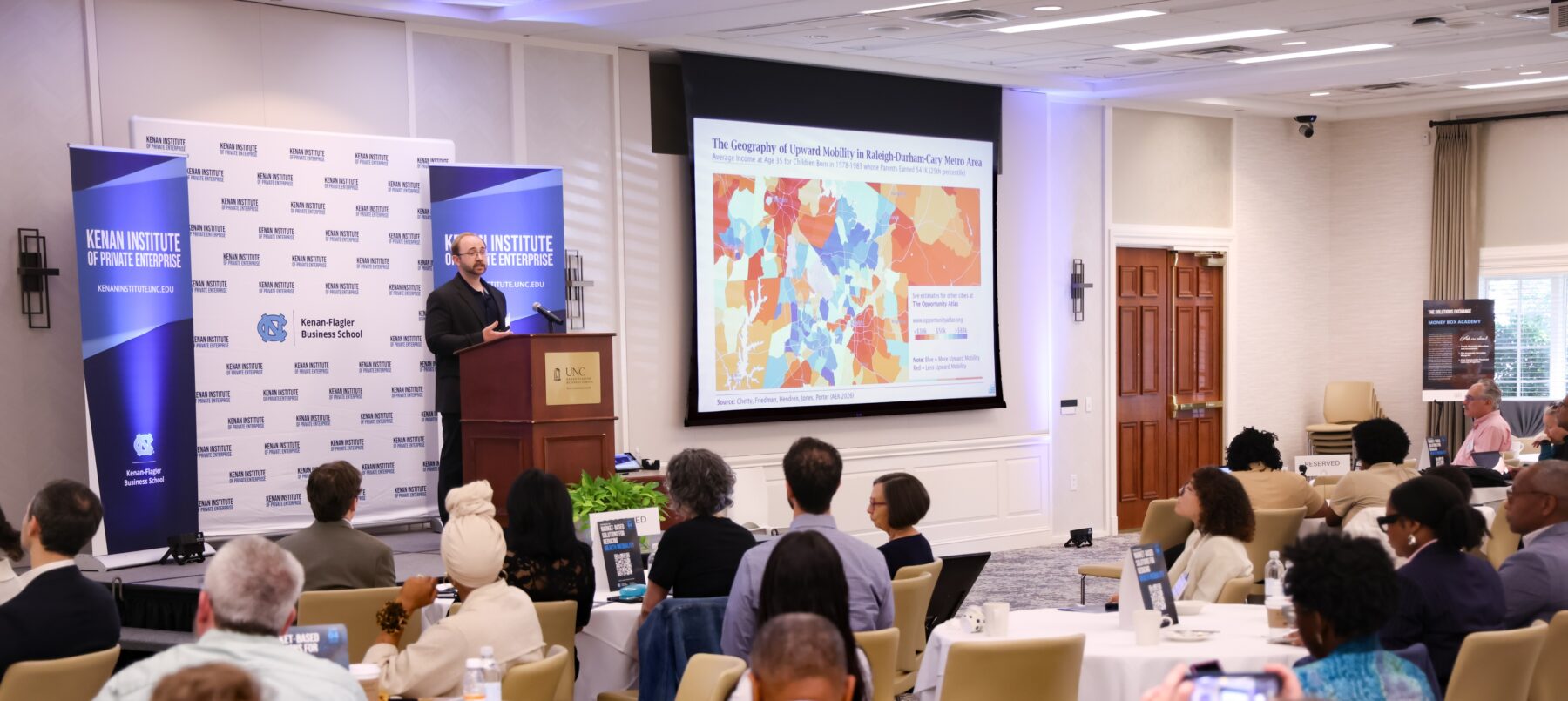
After opening remarks from Banks, a Kenan Institute research fellow and UNC Kenan-Flagler Business School professor of the practice, Harvard economist Gregory Bruich presented findings from Opportunity Insights, where he is a research principal, that opportunities for upward mobility in the US vary dramatically from neighborhood to neighborhood. Bruich’s work shows how a child’s street address can reliably predict lifetime income, health outcomes and other metrics of wellbeing.
Examining these factors at the neighborhood level, Bruich observes that underserved neighborhoods need “bridging capital,” often in the form of broader social connectedness, as well as physical infrastructure investments to improve residents’ economic mobility.
Next, Kala Gibson, executive vice president, head of business banking and chief enterprise corporate responsibility officer at Fifth Third Bank, spoke about the bank’s Neighborhood Program, a place-based vitalization program investing up to $20 million in each of nine US neighborhoods across 11 states from 2019 through 2025. The program has already produced remarkable achievements thanks in part to its innovative design, which entails a mix of funding instruments and a commitment to local stakeholder involvement, trust building and forging long-term partnerships.
Gibson highlighted the program’s success stories, presenting case studies that support place-based investment to build lasting economic vitality at the neighborhood level. Fifth Third Bank is using lessons learned from these investments to expand its Neighborhood Program in the months and years ahead.
A panel of entrepreneurs followed Gibson’s keynote, providing volumes of insights from their experiences helping underserved people and communities fulfill their professional and financial ambitions. Nicole Outlaw, NCGrowth’s assistant director of engagement, moderated the lively conversation, full of powerful anecdotes from those living and working in rural America. The panelists were Dionne Griffin McGee, speaker, author, and founder and CEO of DG McGee Enterprises; Danielle McEwen, senior program manager of startup support with the Center on Rural Innovation; and Crystal D. McLean, president and founder of Money Box Academy Inc.
Covering wide-ranging themes that underscore the importance of access, representation and education, each speaker reflected on their personal and professional odysseys, giving observations from many years of mission-driven work helping people from all backgrounds forge their own paths of professional advancement and economic security. Bringing specific knowledge and financial resources to areas without them, these entrepreneurs embody “bridging capital,” connecting one side of the nation’s wealth divide with the other.
The conference’s afternoon sessions focused on improving access to childcare and affordable housing, two key determinants of household financial health. Neil Harrington, senior director of policy and research for the nonprofit advocacy group NC Child, spoke first, providing a data-backed snapshot of the childcare landscape in North Carolina. In short, childcare is too expensive for parents and childcare providers are not adequately compensated. This market failure, Harrington explains, results in an annual loss of more than $5 billion to the state economy.
Samantha Cole, the child care business liaison for the North Carolina Department of Commerce, then presented on the opportunities for state programs to improve access to childcare in North Carolina, which she described as both a social issue affecting families and a key concern impacting economic development. Cole also discussed some of the challenges her office faces in implementing policies designed to improve childcare access, emphasizing that there is no single solution to the problem, given North Carolina’s size and diverse geographies.
An interactive session followed where representatives from organizations and businesses showcased their innovative approaches and lessons learned from efforts to improve social and business outcomes in many different domains. This session gave audience members the opportunity to converse one-on-one with many of the day’s speakers and other leaders with experience developing and implementing solutions to the challenges discussed throughout the day.
Everyone took their seats after the showcase for the day’s final panel, which delved into a specific childcare solution implemented by two entrepreneurs in partnership with the global shipping company UPS. Sarah Alexander and Olivia Rosenthal, co-founders and co-CEOs of Patch Caregiving, presented their business model of providing affordable on-site childcare for working parents who need help in a pinch. While helping parents in need of inexpensive and convenient childcare, Patch also helps businesses that need the parents they employ to show up to work even when their first childcare option falls through.
UPS is one of these businesses, and panelist Danelle McCusker Rees, senior vice president and global head of talent, culture, and learning at UPS, hired the Patch co-founders to help implement their childcare model there. The company’s Emergency Childcare Initiative is now on-site at UPS facilities in 11 states. Moderated by Iheoma Iruka, UNC Gillings School of Global Public Health professor in the department of maternal and child health, the conversation provided powerful real-world examples of the extraordinary benefits that come from working parents having access to reliable and affordable childcare.
Kenan Institute research economist Sarah Dickerson gave the day’s concluding talk, a presentation on housing affordability in North Carolina. Among the most basic needs, safe and adequate housing is vital to human and economic health. Discussing the Kenan Institute’s recent research on the cost of housing in North Carolina, Dickerson provided a breakdown of how these costs have changed over time as well as housing’s relative affordability given both costs and incomes in all 100 North Carolina counties.
Dickerson emphasized that, without an affordable place to live, individuals and families cannot save money or meet other needs. “We all need access to safe, stable housing that is actually affordable,” she said. “And when that need is met, we can start to meet our other needs, like food, like transportation. We can start to build wealth, save and invest. And we also have money left over to pump into the local economy.”