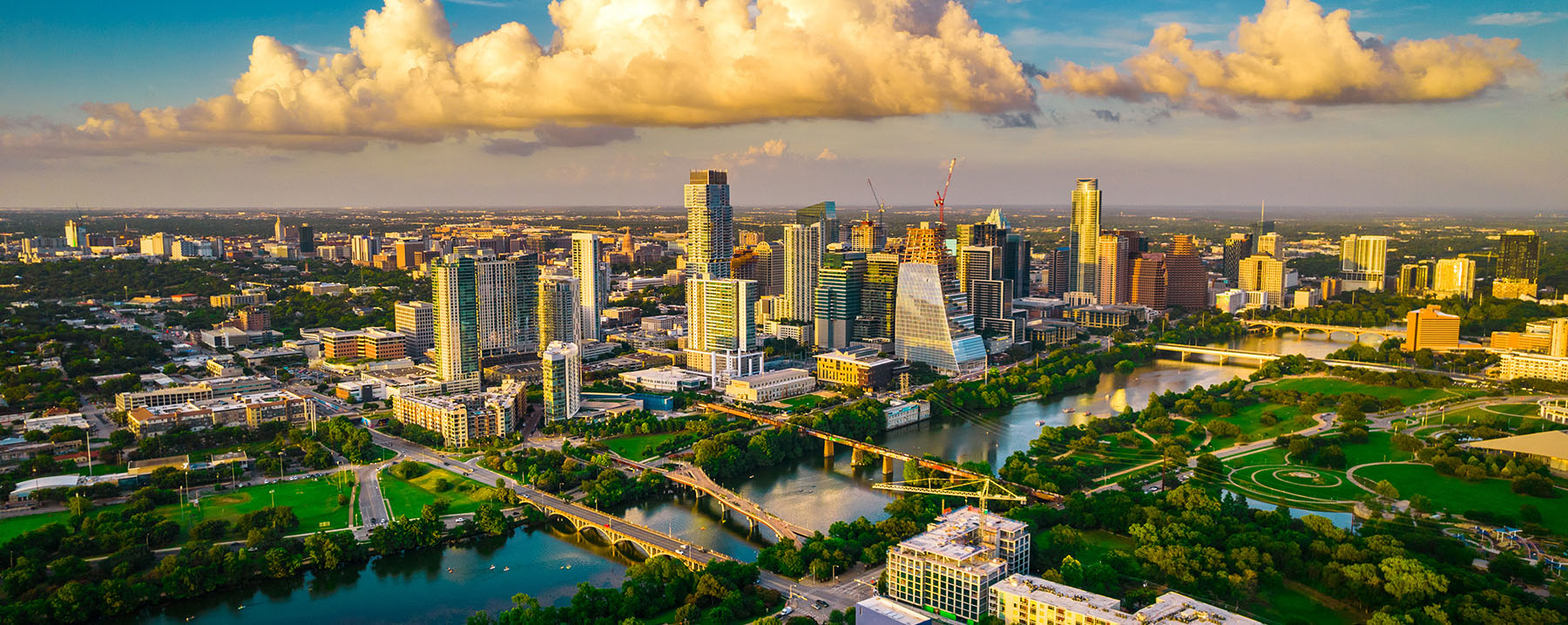


The Empowering American Cities collaboration between the Kenan Institute of Private Enterprise and Fifth Third Bank recently released its 2026 Economic Outlook (registration required), which provides gross domestic product, employment and housing permit growth projections for all 150 Extended Metropolitan Areas across the United States.
In 2025, the US economy proved resilient in weathering significant headwinds, including a cooling labor market, sticky inflation and policy uncertainty surrounding tariffs. Many of these challenges are expected to persist in 2026, and some EMAs will be more resilient than others. Areas that benefit from AI‑driven capital investment, affordability advantages and population inflows are positioned to achieve stronger growth relative to their peers.
Who are the high achievers?
Among the 50 largest EMAs in the United States in 2026, we project the top 10 performers for economic growth as:
1. Austin
2. San Francisco Bay Area
3. Salt Lake City
4. Raleigh and Durham
5. Seattle
6. Nashville
7. Dallas and Fort Worth
8. San Antonio
9. Denver
10. Phoenix
AI Investment, Affordability and Population Growth in the Sun Belt
Of the top 10 EMAs from 2025, nine remain in the top 10 for 2026, with Austin holding the No. 1 spot for the third consecutive year, followed by the San Francisco Bay Area in second place and Salt Lake City in third. The 2026 rankings show the dominance of Sun Belt metros that combine technological advancement with strong inflows of talent and capital. Sun Belt standouts, including Raleigh and Durham, Nashville and San Antonio, demonstrate how affordability paired with artificial-intelligence‑related investment and population growth boosts economic performance.
A closer examination of Austin’s successes sheds light on how the Texas EMA builds resilience to persistent inflation and uncertainty surrounding tariffs and maintains its lead in GDP growth. Housing is a key factor. Austin has prioritized residential construction over the past five years, thereby mitigating building cost increases, and promoted housing affordability relative to other metros. This relative affordability contributes to the EMA’s attractiveness for young talent, which, combined with strong AI investment, produces a robust engine of growth.
Austin is not the only Texas powerhouse: The top 10 in projected GDP growth also include Dallas and Fort Worth as well as San Antonio. A business‑friendly, low‑tax environment and sustained population growth contribute to increases in employment and GDP in these metros. Adding to its economic advantages, Texas has become a major destination for AI‑related capital, with recent announcements for data center and infrastructure projects across the state.
Denver, another Sun Belt metro, replaces Portland in the list of top 10 performers. Employment growth is expected to remain relatively steady in both EMAs, yet Denver benefits from stronger housing permit activity and population growth. Portland, which experienced population losses from 2020 through 2024, is forecast to see weaker housing activity, which is one factor dropping it out of the top 10.
The 2026 rankings reveal a pattern: Regions that benefit from investment in AI, affordability and population growth outperform areas that do not have these advantages. An outsize share of EMAs with these characteristics are in the South, strengthening the region’s economic prominence.
2026 Growth Estimates for the Largest 50 EMAs
The full list of 2026 GDP growth estimates for the 50 largest EMAs is below, along with the change in growth and rank from the previous year. You can sort the table by economic metric by clicking at the top of each column. For example, click on “Change in Growth” to sort ascending, click again to sort descending, and see which EMA economies are estimated to slow down the most and slow down the least from 2025 to 2026.