


The Kenan Institute’s annual Grand Challenge is a concerted yearlong initiative that tackles a vital, pressing issue confronting business and society. Our 2025 effort examines the skills gap in the US economy, the difference between the skills that employers demand from their workforce and the skills that employees possess.
The author acknowledges the helpful research assistance of Rohit Kumar.
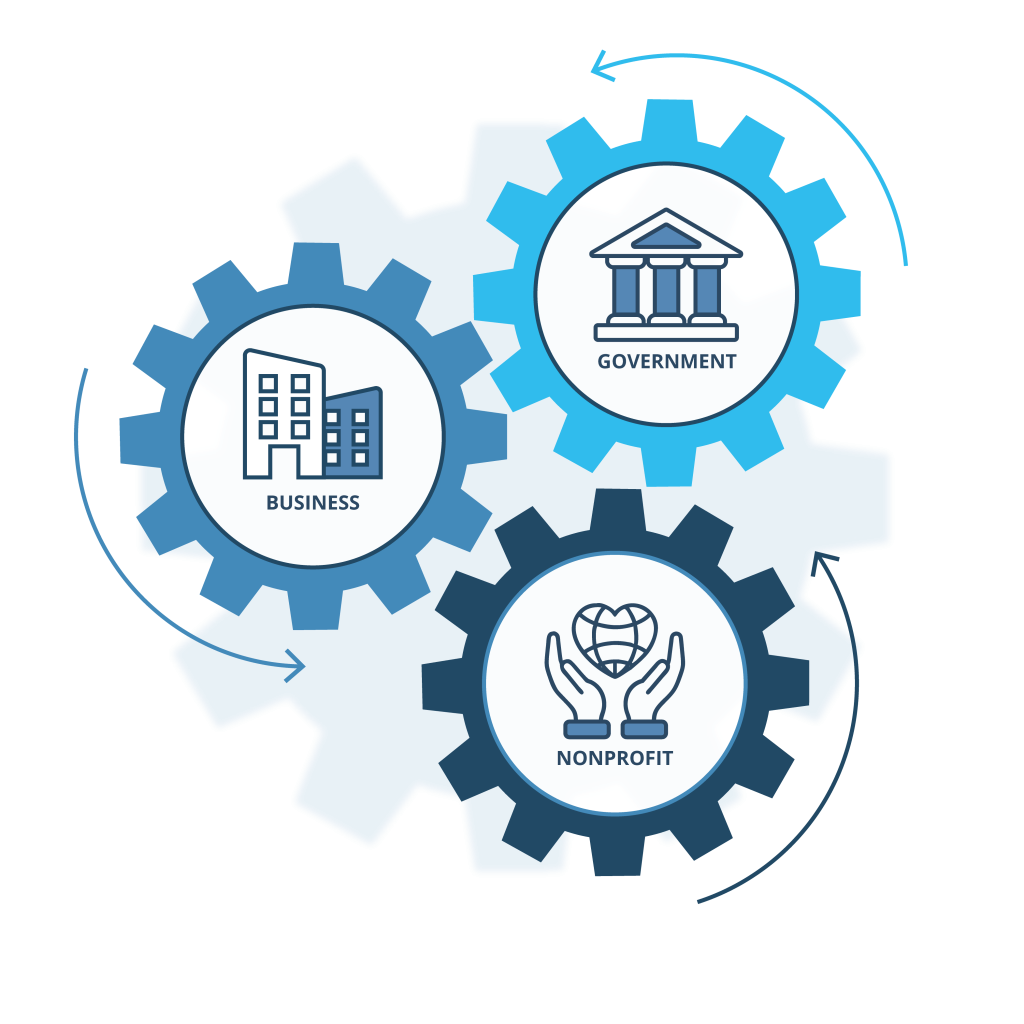
I argue here that cross-sector collaboration and cross-sector partnership – between organizations in the public, private and nonprofit sectors – make up an essential approach to address the skills gap.
While the skills gap is often framed as a shortage of qualified workers, some economists and workforce experts argue that the deeper issue lies in the disconnect between employers (demand) and (education) pipelines (supply). Rather than focusing solely on skill deficits, they advocate for better coordination across sectors.1 In this Insight, I argue that cross-sector collaboration (CSC) and cross-sector partnership (CSP) – between organizations in the public, private and nonprofit sectors – make up an essential approach to address the skills gap.
The literature on CSC and CSP has grown within disciplinary silos, now characterized by varying definitions and frameworks. In 2006, Bryson et al. defined CSC as the “linking or sharing of information, resources, activities, and capabilities by organizations in two or more sectors to achieve jointly an outcome that could not be achieved by organizations in one sector separately.”2 Five years later, Brinkerhoff and Brinkerhoff described public–private partnerships as organizational solutions to pressing problems requiring the comparative advantages of the public, private and nonprofit sectors.3 Meanwhile, Clarke and Crane conceptualize CSPs as “intensive, long-term interactions between organizations from at least two sectors aimed at addressing a problem.”4 Each definition refers to a collaborative arrangement across sectors working together to address a complex social or economic issue.
Yet the literature on CSC/CSP as it relates to the skills gap is limited. Marri and Reyes (2018) offer case studies from New York and Puerto Rico, concluding that private sector “contributions to workforce development and engagement strategies should not be limited to the education sector; collaborations should extend to the local chamber of commerce, community-based organizations, nontraditional workforce training providers, local and state workforce development boards, and financial institutions.”5 Supporting this thesis, Skryd (2022) describes private sector efforts to find talent in Florida’s Tampa Bay area, including Tampa Bay Works,6 an initiative using the U.S. Chamber of Commerce Foundation’s Talent Pipeline Management framework, and LEAP Tampa Bay,7 a local college access network that helped the area earn designation as a Talent Hub8 through its Complete Tampa Bay initiative.9
The co-edited book “The Intersector: How the Public, Nonprofit, and Private Sectors Can Address America’s Challenges” introduces frameworks for CSC/CSP, offering guidance on designing, implementing and measuring outcomes, along with case studies in economic development, education or labor market.10 Prior to this work, The Intersector Project at the Aspen Institute highlights real-world examples from places like New York City, New Hampshire and Washington.11 One standout case: an IBM-led partnership launched Pathways in Technology Early College High School, equipping students with the necessary academic, technical and workplace skills for STEM jobs.12 The P-TECH collaborative model has since expanded to Chicago, in collaboration with Cisco, Microsoft, Verizon and Motorola.13
These examples aren’t one-offs. They reflect a growing recognition that siloed efforts no longer match the scale of workforce challenges.
Cross-Sector Strategies in Practice
This message has not gone unnoticed. Firms and research groups have increasingly pointed to a “cross-sector solution” to the skills gap in the past decade,14 often framing it as a collective action problem and call for “more” and “better” collaboration and/or partnership.15 McKinsey & Co., in “Promoting Cross-Sector Collaboration,” underscores the need for closer coordination, citing Skills for Chicagoland’s Future.16 Reports from Deloitte, Manufacturing Institute and the Association for Talent Development echo this view: Closing the skills gap requires coordination and collaboration among the various private, public and educational sector stakeholders.17
Real-world examples of private sector-led collaboration show how cross-sector partnerships can close the skills gap. JPMorgan Chase launched New Skills at Work, a five-year initiative across six U.S. cities – Boston, Columbus, Dallas, Denver, Indianapolis and Nashville – to align employer needs with training efforts, to support nonprofits providing skills training, and to convene stakeholders to share data and formulate strategies.18 From this work, the firm identified 10 core elements for success. The Urban Institute collaborated with JPMorgan Chase, assessing whether its programs achieved desired outcomes and to inform policy, philanthropy and practice.19 Similarly, the U.S. Chamber of Commerce Foundation’s Talent Pipeline Management initiative strengthens partnerships among workers, businesses, education and government.20 Related programs such as the T3 Innovation Network, Talent Finance, and Employer Provided Innovation Challenges have all emerged from the TPM framework.21
Higher education and nonprofit sector-led cross-sector efforts have also led to impactful cross-sector models in addressing the skills gap. Columbia’s Community College Research Center and West Ed developed regional pathways connecting K–12 schools, colleges and employers, to create corridors to college and career opportunities in their regions.22 A joint initiative from the American Association of Community Colleges and Harvard Business School, Managing the Future of Work, shares insights from interviews with educators and private firms across diverse sectors and geographies.23
The Institute for Networked Communities offers another scalable model for public and private sectors to connect people with jobs.24 Its Next Generation Sector Partnerships –active in more than 100 communities – bring together employers, educators and civic leaders to align regional workforce development strategies.25 Adding to the wealth of information on public sector initiatives, the National Governors Association has shared learning on “skills-based hiring,” which aims to identify the abilities and competencies that a candidate possesses and evaluate whether they match what is needed for an open public sector role.26
Persistent Challenges and Key Questions
Despite promising models, many collaborations still struggle to scale or sustain impact. The success of CSC and CSP is mixed, and key questions remain about what distinguishes effective from ineffective collaboration. Coordination challenges persist, and in many cases actors from the three sectors are unable to collaborate systematically. Educational institutions may train workers in skills not in demand, for instance, or companies invest in training only for employees to leave for another employer. The Boston Consulting Group argues that the public sector must play a role as “orchestrator” of the skills ecosystem. Meanwhile, philanthropic groups have the beneficial combination of risk capital, convening power, knowledge and diversity of cross-sectoral relationships to help address the skills gap.27
Key Takeaways and Questions to Advance Knowledge and Practice
Answers to these questions would advance knowledge and evidence about the practice CSC/CSPs.
- Key dimensions of cross-sector partnership include (a) goal congruence between the parties; (b) alignment of complementary resources; and (c) the ability to measure outcomes. The process unfolds successively and iteratively over time (Klein and McGahan 2021).28 What are the best ways to govern a CSP on the skills gap? And what made intersectoral governance effective or ineffective?
- Philanthropy can fund initiatives that train workers in in-demand skills, support apprenticeships and foster partnerships between the public, private and higher education/nonprofit sector. What roles do philanthropy play in advancing a community or regional-based CSC/CSP?
- A partnership on the skills gap requires agreement on how performance will be measured with timeframes, data sources and methods meaningful to partners. How can the public, private and nonprofit sectors use common indicators for assessing success or failure?
- We need professionals or tri-sector leaders who can bring sectors together to solve problems. What role should higher education have in educating future leaders on the skills and competencies required for cross-sector leadership? 29
If scholars and practitioners evaluate the success and failures on CSP/CCS and share evidence, we could co-produce relevant and timely applied research on cross-sector solutions to address the skills gap in the US and around the globe.
1 Weaver, A. (2024, August 22). The myth of the skills gap. MIT Technology Review. https://www.technologyreview.com/2017/08/25/149485/the-myth-of-the-skills-gap/
2 Bryson, J. M., Crosby, B. C., and Stone, M. M. “The Design and Implementation of Cross Sector Collaborations: Propositions from the Literature.” Public Administration Review 66 (2006, November): 44–55. https://doi.org/10.1111/j.1540-6210.2006.00665.x
3 Brinkerhoff, D. W., and Brinkerhoff, J. M.. “Public–Private Partnerships: Perspectives on Purposes, Publicness, and Good Governance.” Public Administration and Development 31 (2011): 2–14.https://doi.org/10.1002/pad.584
4 Clarke, A., and Crane, A. “Cross-Sector Partnerships for Systemic Change: Systematized Literature Review and Agenda for Further Research.” Journal of Business Ethics150 (2018): 303–313. https://doi.org/10.1007/s10551-018-3922-2
5 Federal Reserve Bank of Atlanta. (2018). Investing in workers, volume 1. In Investing in America’s workforce: Improving outcomes for workers and employers (Vol. 1). https://fraser.stlouisfed.org/title/9405/item/687700
6 Tampa Bay Works – Talent Pipeline Region. (n.d.). https://tools.tpmacademy.org/Network/Tampa-Bay-Works
7 What we do: College access network. Leap Tampa Bay. (2024, August 5). https://leaptampabay.org/about-leap/
8 Tampa bay. Talent Hubs. (2023, July 18). https://talenthubs.org/tampa-bay/
9 Skryd, Jacqueline, “Power of the Collaborative: A Case Study of Businesses Engaging in Cross Sector Partnerships to Find Talent” (2022). USF Tampa Graduate Theses and Dissertations. https://digitalcommons.usf.edu/etd/9818
10 Gitterman, D. P., & Britto, N. (2021). The intersector: How the Public, Nonprofit, and Private Sectors Can Address America’s Challenges. Brookings Institution Press.
11 Preparing students for STEM jobs in New York City at P-TECH. (2017, January 6). The Intersector Project. https://intersector.com/case/ptech_newyork/; Creating a Technical Training Program with Businesses in NH.(2017, January 27). The Intersector Project. https://intersector.com/case/greatbaycc_newhampshire/ ; I-BEST program strengthens adult education in Washington. (2017, January 27). The Intersector Project https://intersector.com/case/ibest_washington/
12 Home – Pathways in Technology Early College High school. (2024, November 5). https://www.ptechnyc.org/; Build Your Future in Tech with Free Learning | IBM SkillsBuild. (n.d.). IBM SkillsBuild. https://skillsbuild.org/students
13Byrne, J. (2012, March 13). Chicago touts high‑tech partnership. Education Week. https://www.edweek.org/leadership/chicago-touts-high-tech-partnership/2012/03
14 Mckinsey.com. Retrieved July 25, 2025, from https://www.mckinsey.com/~/media/mckinsey/featured%20insights/employment%20and%20growth/the%20world%20at%20work/mgi%20global_labor_executive_summary_june_2012.pdf ; Maggioncalda, J. (2023, January 10). Skills-gap crisis: 4 ways the public and private sectors can join forces to reskill workforces at scale. World Economic Forum; https://www.weforum.org/stories/2023/01/skills-gap-public-privatepartnershipsreskilling-workforce-davos2023/
15A collective action problem refers to the challenge faced when an individual or group must cooperate to achieve a common goal. FedCommunities. (n.d.). Investing in America’s workforce. Retrieved July 25, 2025, from https://fedcommunities.org/investing-americas-workforce/; Business Roundtable. (n.d.). Closing the skills gap. In Building America’s ever-ready workforce. Retrieved July 25, 2025, from https://www.businessroundtable.org/policy-perspectives/building-americas-ever-ready-workforce/closing-the-skills-gap; PwC. (2019). Lost workforce: Upskilling for the future. Retrieved July 25, 2025, from https://www.pwc.com/m1/en/world-government-summit/documents/wgs-lost-workforce.pdf; Project on Workforce. (n.d.). College-to-jobs initiative. Harvard Kennedy School. Retrieved July 25, 2025, from https://www.pw.hks.harvard.edu/college-to-jobs; Fuller, J., Raman, M., & Holmes W. (2022, December 12). The partnership imperative: Joint solutions for employers and higher education. Managing the Future of Work, Harvard Business School. Retrieved July 25, 2025, from https://www.hbs.edu/managing-the-future-of-work/Documents/research/The%20Partnership%20Imperative%2012.12.2022.pdf; Community College Research Center & WestEd. (2021). Using guided pathways to build cross-sector pathways partnerships. Teachers College, Columbia University & WestEd. Retrieved July 25, 2025, from https://ccrc.tc.columbia.edu/wp-content/uploads/2021/10/guided-pathways-cross-sector-partnerships.pdf; Reeves, R. V., & Muro, M. (2023, January 12). How U.S. employers and educators can build a more nimble education system with multiple paths to success. Brookings Institution. Retrieved July 25, 2025, from https://www.brookings.edu/articles/how-us-employers-and-educators-can-build-a-more-nimble-education-system-with-multiple-paths-to-success/; Business-Higher Education Forum (BHEF). (2021). Case studies from the Workforce Partnership Initiative (WPI). Retrieved July 25, 2025, from https://www.bhef.com/sites/default/files/BHEF-2020-WPI_CaseStudies-MASTER-2021-v3.pdf; AACSB. (2025). Closing the skills gap with dynamic partnerships. Retrieved July 25, 2025, from https://www.aacsb.edu/insights/reports/2025/closing-the-skills-gap-with-dynamic-partnerships; Business Roundtable. (2024, March 12). Business Roundtable launches new resource to strengthen employer-educator partnerships and fill in-demand jobs. Retrieved July 25, 2025, from https://www.businessroundtable.org/business-roundtable-launches-new-resource-to-strengthen-employer-educator-partnerships-and-fill-in-demand-jobs; Business Roundtable. (n.d.). Corporate initiatives: Workforce Partnership Initiative. Retrieved July 25, 2025, from https://www.businessroundtable.org/corporate-initiatives#workforce-partnership-initiative
16 Promoting cross-sector collaboration: An interview with Penny Pritzker. (2018, August 9). McKinsey & Company https://www.mckinsey.com/industries/public-sector/our-insights/promoting-cross-sector-collaboration-an-interview-with-penny-pritzker; Employment in Chicago | Skills for Chicago – Employment in Chicago | Skills for Chicago. (2025, June 4).
17Sponsored by The Manufacturing Institute and Deloitte. (n.d.). https://www.nist.gov/system/files/2015_skills_gap_report.pdf ; Association for Talent Development. (2015). Bridging the skills gap: Workforce development is everyone’s business (5th ed.). ASTD DBA The Association for Talent Development. https://www.skillsforemployment.org/sites/default/files/2024-01/wcmstest4_180487.pdf
18 JPMorgan Chase established a Workforce Advisory Council, including: the National Academy Foundation, Aspen Institute, the Institute for Public Policy Research, Jobs for the Future, the National Fund for Workforce Solutions, Participle Women Like Us, Year Up, and YouthBuild USA. JPMorgan Chase shared insights from regional workforce development efforts and concluded that talent pipelines require cross-sector solutions. The regional talent partnerships bring together stakeholders from across the education, training, social and business sectors to create strategies. JPMorgan Chase & Co. (2023, October 30). New Skills at Work: First Year in Review. JPMorgan Chase. Retrieved July 25, 2025, from https://www.jpmorganchase.com/newsroom/stories/nsaw-first-annual-report; JPMorgan Chase & Co. (2025, June 26). Business partnerships that grow talent pipelines. JPMorgan Chase. Retrieved July 25, 2025, from https://www.jpmorganchase.com/newsroom/stories/business-partnerships-grow-talent-pipelines; JPMorgan Chase & Co. (2025, June 26). Business partnerships that grow talent pipelines [PDF]. JPMorgan Chase. Retrieved July 25, 2025, from https://www.jpmorganchase.com/content/dam/jpmc/jpmorgan-chase-and-co/documents/business-partnerships-that-grow-talent-pipelines.pdf
19 Urban Institute. (n.d.). New Skills at Work Assessment. In Building America’s Workforce. Urban Institute. Retrieved July 25, 2025, from https://www.urban.org/policy-centers/cross-center-initiatives/building-americas-workforce/projects/new-skills-work-assessment
20 U.S. Chamber of Commerce Foundation. (2024, September 17). Ten years of Talent Pipeline Management. U.S. Chamber Foundation. Retrieved July 25, 2025, from https://www.uschamberfoundation.org/workforce/ten-years-of-talent-pipeline-management
21 U.S. Chamber of Commerce Foundation. (n.d.). T3 Innovation Network. Retrieved July 25, 2025, from https://www.uschamberfoundation.org/solutions/workforce-development-and-training/t3-innovation-network; U.S. Chamber of Commerce Foundation. (n.d.). Talent Finance. Retrieved July 25, 2025, from https://www.uschamberfoundation.org/solutions/workforce-development-and-training/talent-finance; U.S. Chamber of Commerce Foundation. (n.d.). Employer Provided Innovation Challenges (EPIC). Retrieved July 25, 2025, from https://www.uschamberfoundation.org/solutions/workforce-development-and-training/epic
22 Community College Research Center & WestEd. (2021). Using guided pathways to build cross‑sector pathways partnerships. Teachers College, Columbia University & WestEd. https://ccrc.tc.columbia.edu/publications/guided-pathways-cross-sector-partnerships.html
23 Fuller, J. B., & Raman, M. (2022, January). The Partnership Imperative: Community Colleges, Employers, & America’s Chronic Skills Gap. Harvard Business School’s Project on Managing the Future of Work. Retrieved July 25, 2025, from Harvard Business School website: https://www.hbs.edu/managing-the-future-of-work/research/Pages/communtity-college-report.aspx
24 Institute for Networked Communities. (n.d.). Institute for Networked Communities [Homepage]. Retrieved July 25, 2025, from https://www.institutefornetworkedcommunities.org/
25 Institute for Networked Communities. (n.d.). Partnership examples. Next Gen Sector Partnership Community of Practice. Retrieved July 25, 2025, from https://www.nextgensectorpartnerships.com/partnership-examples
26 National Governors Association. (2025, February 6). Empowering Progress: Harnessing skills‑based strategies to drive public sector excellence. NGA. Retrieved July 25, 2025, from https://www.nga.org/publications/empowering-progress-harnessing-skills-based-strategies-to-drive-public-sector-excellence/
27 Khan, Z. “Chapter 12: Challenges in Cross-Sector Collaboration and Learning from Doing.” In The Intersector: How the Public, Nonprofit, And Private Sectors Can Address America’s Challenges (pp. 153–163), edited by D. P. Gitterman, and N. Britto. Brookings Institution Press, 2021.
28 Klein, P. G., and McGahan, A. M. “Chapter 1: Why Intersectional Governance Matters.” In The Intersector: How the public, Nonprofit, And Private Sectors Can Address America’s Challenges (pp. 21–31), edited by D. P. Gitterman, and N. Britto. Brookings Institution Press, 2021.
29 Lovegrove, N. C., & Thomas, M. (2013, February 13). Why the world needs tri‑sector leaders. Harvard Business Review. https://hbr.org/2013/02/why-the-world-needs-tri-sector