
Oct 17, 2026
16th Annual Alternative Investments Conference
Join the Institute for Private Capital for the 16th Annual Alternative Investments Conference on March 21, 2024, featuring a full day of alternative asset programming.
Join the Institute for Private Capital for the 16th Annual Alternative Investments Conference on March 21, 2024, featuring a full day of alternative asset programming.

The crash of the stablecoin TerraUSD last month prompted talk among policymakers of tighter regulations for cryptocurrency markets, a world that was built around the ideas of independence and privacy. In this week’s Kenan Insight, experts who participated in a recent webinar discuss how regulation can move crypto forward and what form new rules and infrastructure might take.

Rethinc. Labs invites you to the Decentralized Finance (DeFi) Conference on Friday, March 4, 2022. The event will be held in person at the Rizzo Center of the UNC Kenan-Flagler Business School in Chapel Hill.

Consumers will long associate the early months of the COVID-19 pandemic with seemingly apocalyptic searches for toilet paper, hand sanitizer and PPE. But even now, amid continued surges of the Delta variant, many global supply chains continue to experience disruptions at record rates. This week’s Kenan Insight invites our experts to weigh in on the immediate impact of these disruptions for business and society, the longer term effects across industries and the roles government and emerging tech should be playing to drive solutions.

Could new legislation help drive the development of local tech clusters – and the growth of corresponding economic power and development – beyond Silicon Valley? In this week’s Kenan Insight, our experts explore the gravitational pull of Big Tech along with what it could mean if startups across the U.S. were better able to remain and grow in the communities where they launch.

As The Wall Street Journal reported this week, Congress is gearing up for a potential showdown with the largest tech companies in the U.S. And with a bipartisan group of representatives pushing for legislation that would dismantle the monopoly power of Big Tech, this week's Kenan Insight revisits research on how regulating Amazon, Apple and others may be key to reviving the economies of America’s held-back cities and regions.

AI. CRISPR. mRNA. Key components of the rapidly expanding alphabet soup of technologies driving a boom in healthcare innovation. In this Kenan Insight, we explore why the 2021 Trends in Entrepreneurship Report names emerging technology in the healthcare industry as a key trend, along with some of the challenges that come with fast-moving technological advancements.

Corporate executives have begun to glimpse the strategic value of incorporating artificial intelligence as an “employee” within their organization. In this Kenan Insight, we explore a framework that outlines the critical elements for harnessing the potential of human-AI working relationships.

Cryptocurrency has its critics, but it’s becoming an increasingly mainstream option for retail and institutional investors alike. In this Kenan Insight, we share some thoughts from former Co-president of Morgan Stanley Zoe Cruz and Rethinc. Labs Faculty Director Eric Ghysels on whether crypto has reached a tipping point for adoption by individual investors.

UNC Professor of Economics, UNC Kenan-Flagler Business School Professor and Kenan Institute Senior Faulty Fellow Anusha Chari's latest research was featured in a recent National Bureau of Economic Research article. Chari's co-authored paper with Kenan Institute Director of Research Christian Lundblad and Federal Reserve Bank of Kansas City Economist Karlye Dilts-Stedman, is cited in the article that looks at capital market risks in emerging markets.

Join our retail faculty and industry experts as they discuss the development of new online platforms and delivery options, the management of supplier relationships, evolving customer demand and expectations and changing personnel needs and safety.

There is growing evidence that many multinational corporations are lowering their tax obligations by engaging in income shifting—moving income from high-tax countries to low-tax countries or tax havens, and shifting deductions from low-tax countries to high-tax countries. By at least one estimate, the result is loss of nearly $100 to $240 billion annually in global tax revenues. In this Kenan Insight, we explore the extent of the problem and what might be done to address it.

Prior to the COVID-19 outbreak, institutions of higher education were under immense pressure to live up to their value propositions, with underlying tensions that have been developing for years posing an existential threat to their financial viability. As colleges and universities move classes and operations online in response to the pandemic, questions arise as to what such changes hold not just for now, but for the long-term success of higher education. Can ed tech provide a way forward? Find out in this week’s Kenan Insight.

While technological advances have traditionally been a boon to the U.S. economy, the rapid rise of new platforms and the increased financialization of the economy in recent years have encouraged the growth of monopolies—driving an ever-widening geographic gap in the distribution of income across the country. New research from the Kenan Institute’s Professor Maryann Feldman explores the ramifications of this growing divide.

China’s venture capital funding has contracted significantly since mid-2018. According to Christian Lundblad, director of research at the Kenan Institute, this is a byproduct of U.S. trade policy, some domestic Chinese investment policy and the usual ups and downs in a developing market.
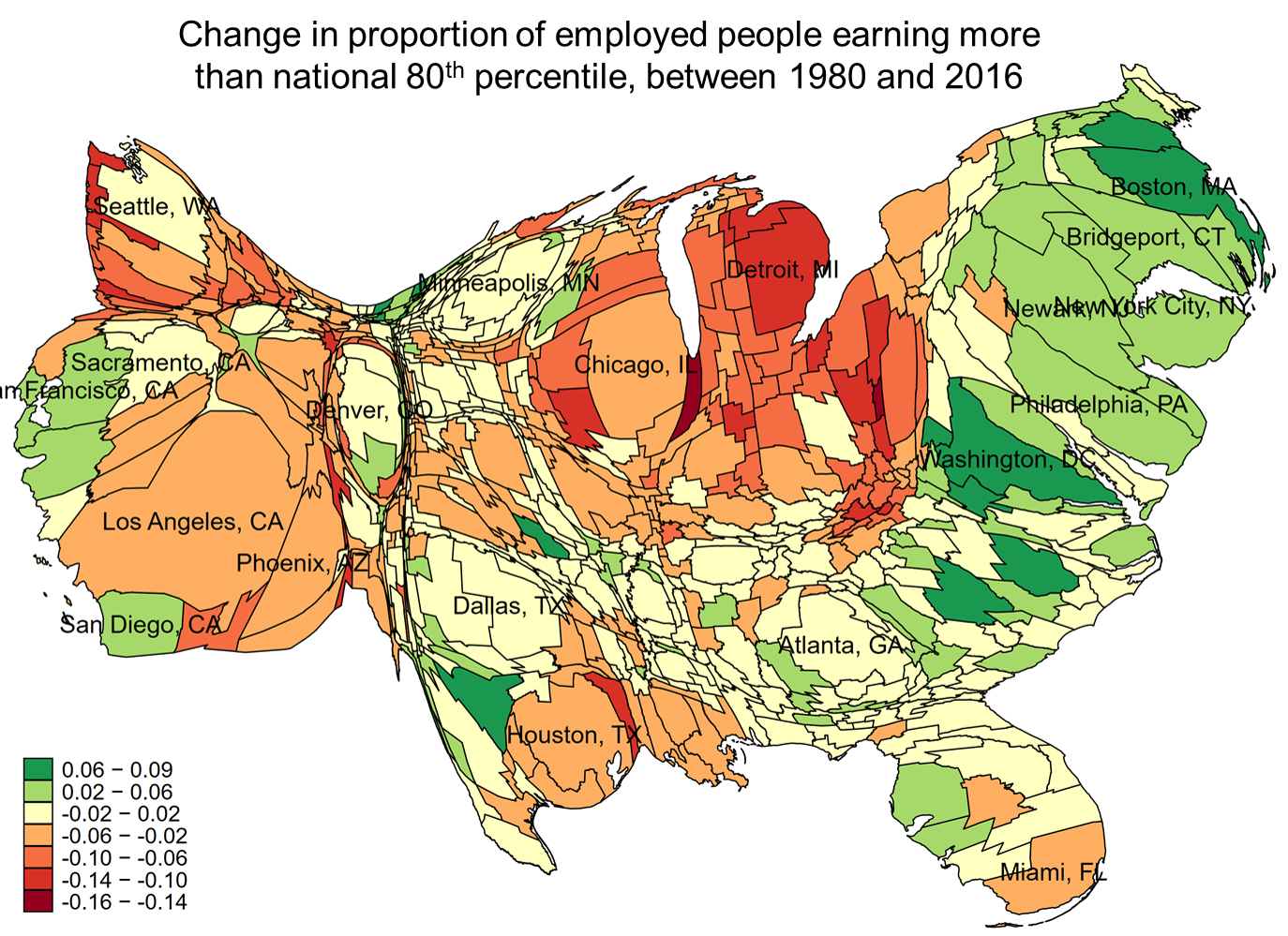
In a new study, researchers examine how the rising economic power of technology and finance firms has contributed to regional income disparities across America.

In partnership with Vista Equity Partners, NCIF hosted the inaugural Software Growth & Investment Symposium on Tuesday, Nov. 12, 2019. The event brought together members of the Triangle’s burgeoning tech ecosystem to learn from leading software executives and their investors about proven approaches to scaling from $10 million to $100 million annual recurring revenue.

The growing use of predictive analytics to analyze manufacturing plant data has increased factory efficiency while re-shaping the employment relationship among both managers and factory floor employees, according to a new study from Eva Labro, Professor of Management Accounting, UNC Kenan-Flagler Business School; Mark Lang, Professor of Accounting, UNC Kenan-Flagler Business School; and Jim Omartian, Assistant Professor of Accounting, University of Michigan’s Ross School of Business.