stakeholder capitalism

Business Stakeholders

Why Both Sides of the ESG Debate Have It Wrong (And How to Get It Right)

There are few topics in business more current, more covered or more controversial than corporate environmental, social and governance (ESG) responsibilities. Proponents claim a business’s adoption of such principles yields outcomes that benefit all parties, driving win-win scenarios for internal and external stakeholders alike. But critics dismiss ESG implementation as a performative PR ploy, and argue that considering such non-pecuniary factors in corporate decision-making is unsustainable. Our (independent, nonpartisan) findings indicate both sides of the debate are missing the mark – and in hopes of advancing more productive conversations, we introduce below a research-based model for examining the trade-offs of ESG adoption for businesses large and small.

Stakeholder Capitalism

U.S. Economic Experts Weigh In on Stakeholder Capitalism

UNC Kenan-Flagler Business School Professor Camelia Kuhnen was among a group of economists who answered questions for a survey on stakeholder capitalism by the Initiative on Global Markets at the University of Chicago Booth School of Business. Considering one statement – “Effective mechanisms for boards of directors to ensure that CEOs act in ways that balance the interests of all stakeholders would be straightforward to introduce” – Kuhnen objected strongly

Earth & Environment

Is Patagonia’s Yvon Chouinard a Stakeholder Capitalist or an Altruist?

Patagonia founder Yvon Chouinard and his family will transfer ownership of the company – valued at roughly $3 billion – to two newly created environmental trusts. In this Kenan Commentary, we ask four questions to determine how Chouinard’s move fits into the framework of the institute’s annual theme, stakeholder capitalism, and whether a better comparison is the laudable but more common idea of an altruistic business owner.

Stakeholder Capitalism

Van Saun Gift Will Support Grand Challenge, Distinguished Fellows

A new personal gift from Bruce Van Saun, Citizens Financial Group Inc. chairman and CEO, and his wife, Kathleen (Katie) Van Saun, will support the Kenan Institute’s annual grand challenge. Starting in 2023, the three-year gift will support the institute’s Distinguished Fellows, who advance thought leadership around the grand challenge’s theme, a key issue that affects business and society. The program is making its debut this year with an exploration of stakeholder capitalism and ESG investing. The Van Sauns earned their MBAs from UNC Kenan-Flagler Business School in 1983 and were married in 1985.


How to Grow Diversity in High-Growth Startups

How to Grow Diversity in High-Growth Startups

Some analysis indicates companies with diverse executive teams drive more revenue and are more likely to experience higher profits relative to their nondiverse peers, yet founding teams for both high-growth startups and the private capital groups that fund them stand in stark contrast to the U.S. working age population. Why? And why should it matter? In this week’s Kenan Insight, Kenan Institute Distinguished Fellow Emmanuel Yimfor unpacks statistics on the composition of both high-growth startups and private capital groups, explores the economic and societal implications of their lack of diversity and provides suggestions to facilitate change.

Should Companies Buy Into Employee Ownership?

Should Companies Buy Into Employee Ownership?

Pete Stavros of KKR & Co. founded Ownership Works, a new initiative backed by 19 private equity firms, with the objective of reducing income inequality by increasing employee share ownership. The group has prominent backers and a lofty goal of creating $20 billion in wealth in 10 years. As a researcher who has worked on employee share ownership and the benefits it can create, I was encouraged by the news. But while I broadly support employee ownership, such initiatives also can raise red flags because of the risk they impose on employees. As such, it is worthwhile to think carefully through what we know and don’t know about such programs.

European-energy-oil-gas
May 24, 2026

Webinar: Addressing Europe’s Energy Dilemmas in a Global Context

Further embracing renewable energy sources can help in the long term, but short- and medium-term solutions will require other answers. Join us for a virtual discussion at 11 a.m. June 20 as Stephen Arbogast, Kenan-Flagler Business School Finance Professor and director of the Energy Center, talks with Chief Economist Gerald Cohen about how focusing on the global energy supply can help Europe select the best options for creating a more stable energy outlook.

Diversity, Equity and Inclusion

A New Approach to DEI, and Why the Time Is Right

UNC Kenan-Flagler Business School Professor Al Segars and co-author Anselm Beach have written about their new model for developing diversity, equity and inclusion in an organization, the Values/Principles Model, in the most recent issue of the MIT Sloan Management Review. At a time when recognition of DEI’s benefits has become widespread, their approach gives leaders the tools to create real change that will allow their whole companies to prosper. Learn more by clicking below.

What ESG-Focused Investors Need to Know in 2022

What ESG-Focused Investors Need to Know in 2022

There’s no escaping the growing interest in environmental, social and corporate governance investing, but not everyone agrees on how to define, measure or report the variety of factors considered under ESG. Professor Laura Starks of the University of Texas McCombs School of Business spoke on the subject in May at the Alternative Investments Conference, sponsored by the Institute for Private Capital. Starks’ keynote speech, highlighted here, examined the knowns and unknowns of ESG investing as well as new regulations that may be coming.

Profits Planet

LBS Professor Alex Edmans Q&A: Power, Profits and Purposeful Business

London Business School Professor Alex Edmans, a 2022 Kenan Institute Distinguished Fellow, followed up his recent virtual presentation on “The Power of Purposeful Business” by answering key questions from the audience. This week’s Kenan Insight offers a curated Q&A with a few of our favorites, with Professor Edmans tackling topics such as which issues government is best equipped to regulate and which may require shareholders to step in, the limits of using data in ESG measurement, and how best to encourage purposeful thinking throughout an organization.

Stakeholder Capitalism

Kenan Institute Announces 2022 Class of Distinguished Fellows

The Frank Hawkins Kenan Institute of Private Enterprise is thrilled to announce its 2022 class of Distinguished Fellows. Appointed on an annual basis, the Distinguished Fellows comprise an exemplary set of global scholars committed to leveraging their individual expertise, thought leadership, research and networks to further the institute’s efforts to examine and drive solutions to issues facing business and the economy today.

The Power of Purposeful Business

The Power of Purposeful Business

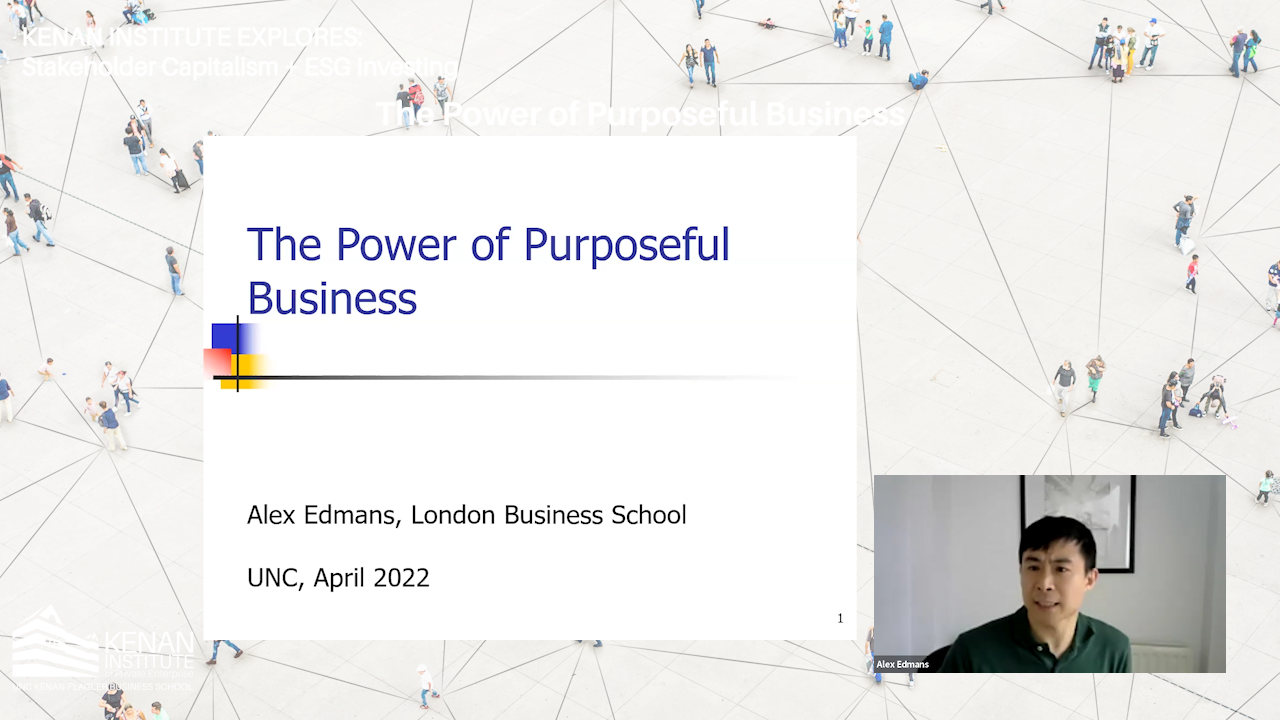
Purpose is the corporate buzzword of today, with politicians, the public and even shareholders calling on businesses to serve wider society. But purpose is also controversial, because companies have a responsibility to deliver returns to investors. Is there a trade-off between purpose and profit, or is it possible for companies to achieve both? The Kenan Institute of Private Enterprise hosted a virtual talk featuring London Business School Finance Professor Alex Edmans, who critically examined the case for purposeful business using rigorous evidence and real-life examples to show what works – and, importantly, what doesn’t. He discussed practical ways for businesses of all sizes to put purpose into practice, how investors and citizens can play their part, and how we can distinguish businesses that are truly purposeful from those that are greenwashing.

The Surprising Complexities of Measuring ESG

The Surprising Complexities of Measuring ESG

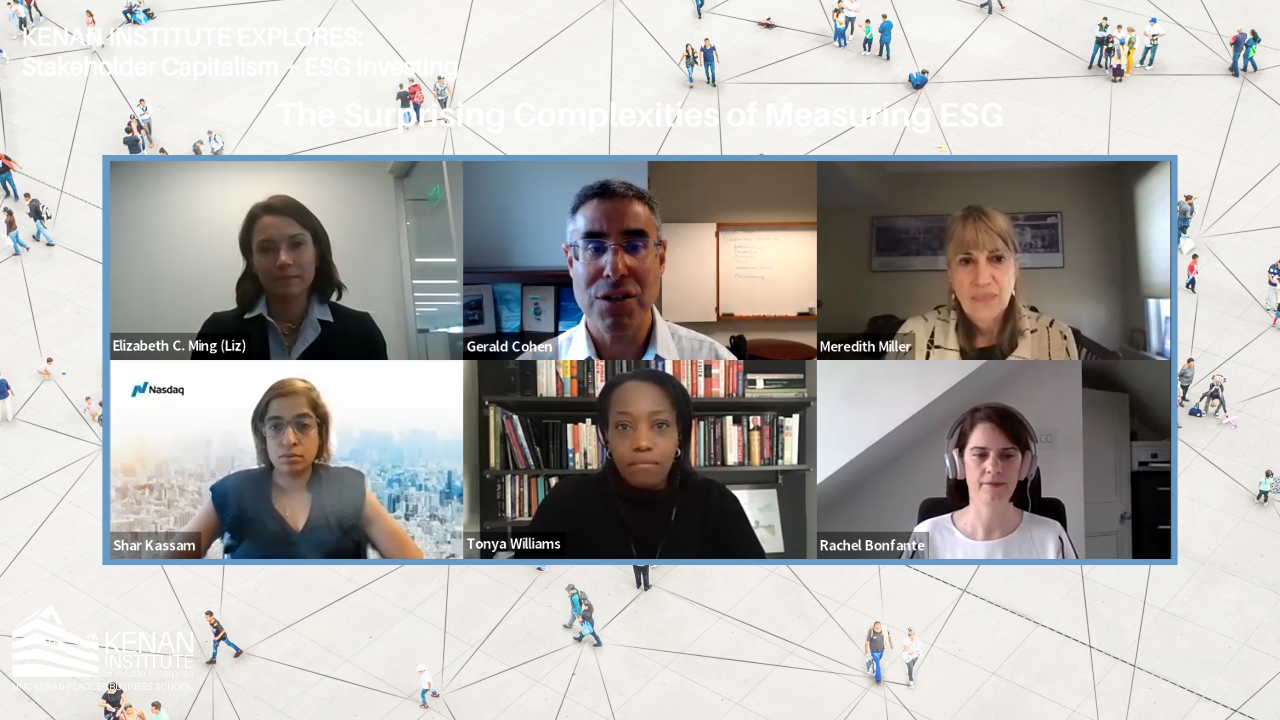
The Kenan Institute’s deep dive into stakeholder capitalism has exposed shortcomings in a key building block: ESG measurement. Our experts have explored the issue at length, proposing ways of refining these measures to produce structures that could meet the needs of multiple stakeholders while also working to design reporting free from political influence and agendas. As a next step, the Kenan Institute hosted a conversation featuring a business leader, investor and standard setter to discuss how we might turn these ideas into solutions to help integrate stakeholder capitalism principals into business and investment decisions.

Kenan Institute Data Graph
May 24, 2026

Webinar – The Surprising Complexities of Measuring ESG

The Kenan Institute’s deep dive into stakeholder capitalism has exposed shortcomings in a key building block: ESG measurement. In this one-hour virtual session, we will convene a cross-sector group of panelists to discuss why ESG measurements matter to businesses large and small. The panelists will offer recommendations on scalable implementation, suggest how best to leverage such measures to meet the needs of different stakeholder groups, and provide tips on how to design reporting that is free from political influence and agendas.

Earth - Climate Change

Can Entrepreneurs Save the Planet?

With a recent report from the United Nations warning that climate change has already begun to cause irreversible damage, experts during the 2022 Kenan Institute Frontiers of Entrepreneurship Conference discussed the role innovation can – and should – be playing to combat these ill effects. This week’s insight explores the topic through Q&A with Dr. Eric Toone, executive managing director and technology lead at Breakthrough Energy Ventures, and Dr. Jacqueline Pless, the Fred Kayne (1960) Career Development Professor of Entrepreneurship at MIT Sloan School of Management.

Can the West Sustain Sanctions Against Russia?

Can the West Sustain Sanctions Against Russia?

Together with many business and economic leaders around the globe, we at the Kenan Institute of Private Enterprise support the harshest feasible sanctions against Vladimir Putin in the immediate interest of Ukraine and its people. More broadly, we view such measures as vital to the long-term survival of democratic values. But as the Russian invasion continues, seemingly unabated by unprecedented economic and financial sanctions, we must ask: what more is feasible? And for how long can such restrictions be sustained?

Accounting

ESG Measurement: A Surprisingly Complex Issue

ESG measurement and impact accounting can have vast economic and social influence; however, implementation is extremely challenging for both businesses and policymakers. In this week’s insight, our experts propose ways of refining ESG measures to produce structures that meet various stakeholder needs, drive reporting free from political influence and agendas, and illustrate the promise and risks of impact accounting.

Earth - Climate Change

Climate mitigation is an imperative, but it’s not part of the Fed mandate. Nor should it be.

As part of President Joe Biden’s efforts to refocus the Federal Reserve Board, the Senate conducted confirmation hearings for several nominees this past week. While these hearings traditionally raise spirited exchanges about the nominees’ views on monetary policy and bank supervision, a new and more controversial topic involves the extent to which the Federal Reserve should internalize climate risks into its purview. Before wading into central bank wonkishness, it is important to make clear that climate change represents a serious risk to not only the U.S. economy but to humanity itself. Nevertheless, we need to be very deliberate in the assessment of the available policy tools, with an eye to where unintended consequences may reside.

Office Space Workers

A Different Business Case for Diversity

Greater focus on social justice has brought systemic inequities in the corporate sector to light, leading companies to step up their efforts in attracting and retaining a diverse workforce – but many challenges remain in implementing those goals. Following a joint report between the Kenan Institute and EY, this week’s Kenan Insight breaks down some challenges companies may face while trying to reach their diversity, equity and inclusion goals.

Shareholder Capitalism

Is Shareholder Primacy the Democracy of Capitalism?

A look at stakeholder capitalism – the idea that businesses would improve societal outcomes by focusing on a mandate broader than that which benefits shareholders alone – starts with the existing best-practice model: shareholder capitalism. This model, while not perfect, can produce the optimal amount of goods and services at the lowest cost. This week, Kenan Institute experts explore ways to improve it and examine whether stakeholder capitalism is ready to take its place.