


Employers aren’t struggling to find candidates with technical know-how. The harder part, many say, is finding workers who can collaborate, lead and communicate effectively. New survey data confirms this: According to the National Association of Colleges and Employers,1 96 percent of employers identify communication as one of the most important career readiness competencies, yet only half of them rate recent graduates as very or extremely proficient. NACE also reports sizable gaps in other core skills, with leadership and professionalism lagging employer expectations by roughly 30 percentage points.
The consequences are significant. Deloitte’s 2025 Global Human Capital Trends2 survey found that two-thirds of managers and executives believe most recent hires are not fully prepared, citing lack of experience as the most common shortfall. For many employers, that gap shows up in soft skills such as teamwork, problem-solving and navigating workplace dynamics.
Addressing these gaps takes more than one-off workshops or generic “professional development” sessions. It calls for a deeper approach to preparing employees to lead themselves, others and their organizations. At North Carolina State University, the Shelton Leadership Center has been experimenting with just that, embedding values-based leadership into programs that build not only technical expertise but also the interpersonal confidence and decision-making skills today’s workforce demands.
We spoke with Director Debbie Acker, Associate Director Dustin Evatt and Senior Associate Director Tiffany McLean about how values-based leadership can help close the leadership gap and what lessons employers can take away.
Employers say younger workers are quick to leave jobs if they don’t feel connected. How can values-based leadership help organizations keep talent engaged?
“Values-based leadership is about being clear on your purpose and using your values to guide decisions and actions.”
Acker: Values-based leadership is about being clear on your purpose and using your values to guide decisions and actions. For younger employees especially, alignment really matters. They want transparency, they want to know their voice counts, and they want to feel their work connects to something bigger. If they don’t see that, they’ll move on quickly — even if the salary is good. It’s less about money and more about whether they feel valued and connected.
“When employees can link their own values to the organization’s mission, they feel invested.”
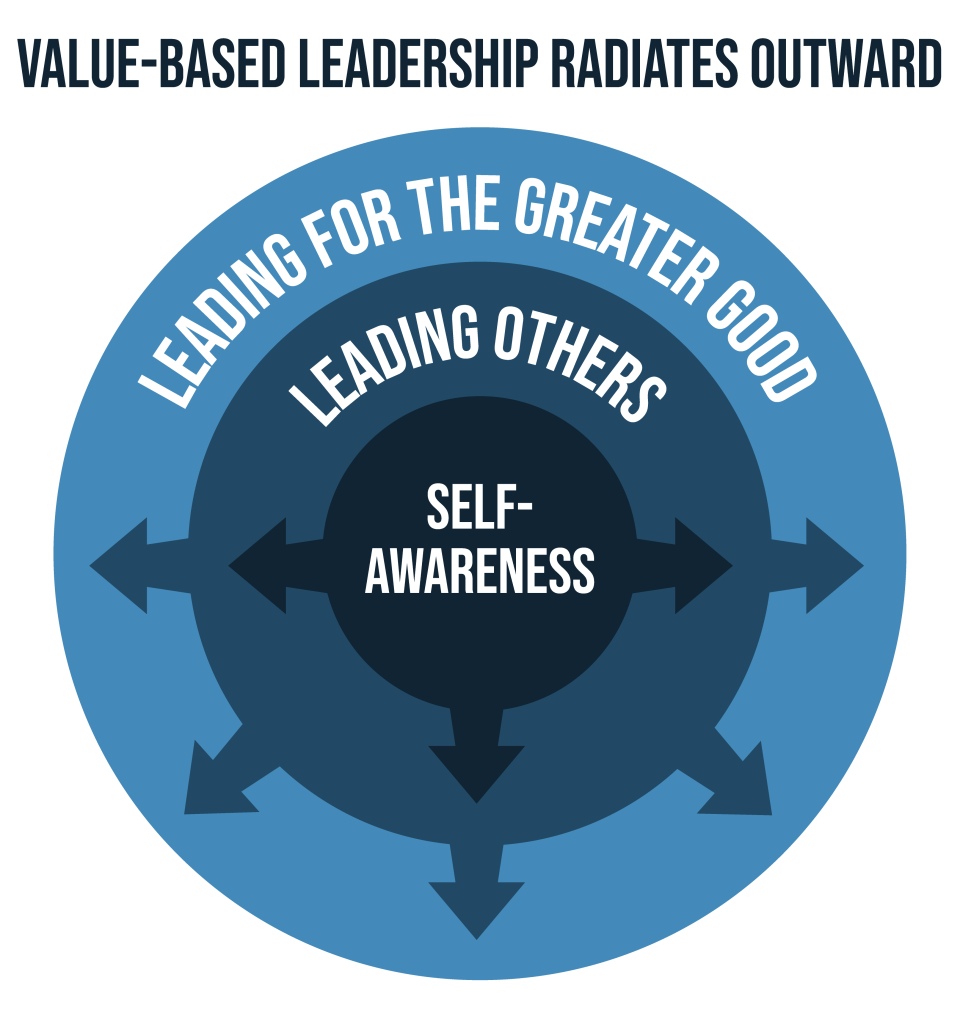
Evatt: Our model of leadership is built around concentric circles: It starts with leading self, then leading others, then leading organizations, and finally leading for the greater good. At the center is self-awareness – knowing what you value and how that shows up in your behavior. When employees can link their own values to the organization’s mission, they feel invested. That’s when you see real engagement and retention.
McLean: We see this most clearly in the Chancellor’s Leadership Development Program, which works with rural and first-generation students. In the first year, they spend a lot of time on self-reflection. By the second, they’re practicing giving and receiving feedback, and by the third, they’re leading events and retreats for their peers. That step-by-step approach builds confidence and purpose. When people feel their values are supported and developed like that, they’re far more likely to stay committed.
Technical skills may get someone in the door, but they don’t guarantee success. What leadership competencies matter most for early-career employees trying to thrive on teams?
McLean: Communication and interpersonal skills are the foundation. Before you can contribute effectively to an interdisciplinary team, you have to know how to build trust and communicate across different audiences. Without that, the whole system crumbles. We hear from employers again and again that this is where new hires struggle most.
Acker: I’d add curiosity and the courage to ask questions. Too many young employees feel pressure to always have an answer, and that keeps them from engaging fully. Leadership isn’t about having all the answers – it’s about asking the right ones in a way that invites trust and curiosity rather than tension. How you ask matters too; questions asked with curiosity build trust instead of tension. When employees lean into inquiry, they grow faster and make better decisions.
Evatt: For me, teamwork is the proving ground. Employers hire for subject matter expertise, but what sets someone apart is their ability to translate expertise across disciplines and contribute to a common mission. That takes self-awareness, clear communication and respect for others’ perspectives.
Onboarding is often where employees first learn the ropes. How can organizations weave values-based leadership into those early experiences so teams perform better in the long run?
Evatt: Reflection is a powerful place to start, and intentionality matters. Onboarding shouldn’t just be about policies and systems – it should help employees connect their personal values to the organization’s mission. That can happen in check-ins with managers, structured reflection activities or even team discussions about purpose. When people see the link early, they’re more likely to feel engaged and committed.
Acker: The key is that training can’t be a one-off event. It’s not a one-and-done workshop. It has to be reinforced over time and embedded in the organization’s culture. We talk about scaffolding – building layers of leadership opportunities so employees keep developing as they grow into their roles. And it can’t be siloed by department. When engineers understand what finance contributes, or when marketing appreciates operations, everyone starts to see themselves as part of the bigger picture.
McLean: I’d also emphasize the role of managers. You can teach entry-level employees about values and communication, but if their supervisors don’t model it, the culture won’t stick. Midlevel managers need training, too, because they’re often the bridge between strategy and day-to-day work. Employees also need to feel safe to speak up, and generational dynamics play a role in whether they will. Organizations that create space for those conversations will see stronger performance and retention.
Business leaders often point to communication as the biggest gap in new hires. Do you see this as a generational problem or a continuing challenge that just looks different today?
“Many early-career employees have the skills but hesitate to use them because they’re afraid of failing or saying the wrong thing.”
McLean: I think it’s less about a lack of ability and more about confidence. Many early-career employees have the skills but hesitate to use them because they’re afraid of failing or saying the wrong thing. They need to feel safe to speak up. Without that space, it looks like a communication problem when it’s really a confidence issue.
Acker: Leaders need to remember what it felt like to be new. We sometimes forget our own early careers, when we didn’t yet have decades of experience to draw on. Communication has always been evolving, influenced by culture, technology and even social media. The challenge for leaders is adaptability, being mindful of shifting norms while creating safe spaces for employees to grow.
Evatt: Communication has always been central to leadership. It’s socially constructed. The way we practice it shifts with culture, technology and generational norms. The real skill is adaptability: learning to navigate those shifts effectively.
McLean: I’d also note that we have fewer formal leadership training pipelines today than in past generations. Years ago, many employees came up through military or corporate programs that invested heavily in communication and leadership development. Companies have cut back on that, and we’re seeing the consequences. If organizations want better communication, they have to reinvest in intentional training.
If you could give one piece of advice to employers looking to close leadership and communication gaps in their workforce, what would it be?
Acker: Take the time to understand the diverse experiences and communication styles your employees bring. When people feel seen and valued, organizations become stronger.
Evatt: Start with values alignment. Help employees connect their personal values to the organization’s mission, and you’ll see deeper engagement and commitment.
McLean: Don’t treat leadership as something that only applies to people with a title. Values-based leadership has to happen at every level, from new hires to senior managers. When organizations invest in that across generations, they’re better prepared to thrive.
1 National Association of Colleges and Employers. (2025, January 13). The gap in perceptions of new grads’ competency proficiency and resources to shrink it https://www.naceweb.org/career-readiness/competencies/the-gap-in-perceptions-of-new-grads-competency-proficiency-and-resources-to-shrink-it
2 Deloitte. (2025, March 24). 2025 Global Human Capital Trends: Turning tensions into triumphs. Deloitte Press Release.https://www.deloitte.com/us/en/about/press-room/deloitte-report-aims-to-help-leaders-navigate-complex-workplace-tensions.html