
Oct 17, 2026
17th Annual Alternative Investments Conference
Registration is open for the 17th annual Alternative Investments Conference on March 27, hosted by the Institute for Private Capital.
Registration is open for the 17th annual Alternative Investments Conference on March 27, hosted by the Institute for Private Capital.

The growth of the venture capital market should not blind one to its limitations as an engine of innovation. Kenan Institute Distinguished Fellow Josh Lerner lays out three areas of concern worthy of more research.

Join the Institute for Private Capital for the 16th Annual Alternative Investments Conference on March 21, 2024, featuring a full day of alternative asset programming.

Since 2008, the Alternative Investments Conference has served as a forum for private equity, hedge fund, venture capital and other alternative asset professionals to network, share ideas and stay abreast of industry trends.

Thought leaders, policymakers, business leaders, experts, government officials, researchers, scholars and other key stakeholders convene for a two-day event focused on the latest issues impacting the fintech ecosystem.

The symposium will highlight recent research on buyouts, private credit, and venture capital, among other topics. Hosted by the Private Equity Research Consortium (PERC).

Kenan Institute Distinguished Fellow Emmanuel Yimfor of the University of Michigan Ross School of Business tells leaders that when there are no win-win solutions among stakeholders, it’s important to explain the issues that are at the heart of stakeholder capitalism.

Yimfor, a Kenan Institute Distinguished Fellow, will discuss his recent work on how access to venture capital varies by the founder’s race and alma mater and explore mechanisms driving the variation.

Some analysis indicates companies with diverse executive teams drive more revenue and are more likely to experience higher profits relative to their nondiverse peers, yet founding teams for both high-growth startups and the private capital groups that fund them stand in stark contrast to the U.S. working age population. Why? And why should it matter? In this week’s Kenan Insight, Kenan Institute Distinguished Fellow Emmanuel Yimfor unpacks statistics on the composition of both high-growth startups and private capital groups, explores the economic and societal implications of their lack of diversity and provides suggestions to facilitate change.

A panel from this year's Alternative Investments Conference discusses how venture capital is playing catch-up on ESG investing, "knowing what levers you can pull," and the opportunity for huge growth in this week's Kenan Insight.

As venture capital markets have surged in recent years, early access to capital remains highly localized. We examine changes that can help investors connect with underrepresented entrepreneurs outside traditional funding hubs, from innovative organizations to improvements in transportation.

Does the quality of startups increase when the quantity drops? Does entrepreneurial experience help or hurt a corporate job candidate? Do diverse teams make for better startups? The 2022 Trends in Entrepreneurship report brings together our global network of affiliated experts to address these questions and more – with key findings highlighted in this week’s insight.

With a recent report from the United Nations warning that climate change has already begun to cause irreversible damage, experts during the 2022 Kenan Institute Frontiers of Entrepreneurship Conference discussed the role innovation can – and should – be playing to combat these ill effects. This week’s insight explores the topic through Q&A with Dr. Eric Toone, executive managing director and technology lead at Breakthrough Energy Ventures, and Dr. Jacqueline Pless, the Fred Kayne (1960) Career Development Professor of Entrepreneurship at MIT Sloan School of Management.

Total funding in North Carolina hit a record $3.4 billion in 2020 with the potential to hit $4 billion in 2021, along with a 10% increase in the number of companies funded, but it’s often a challenge to get cash cycled into new companies and new investments.

This session delves into three critical aspects of smaller/regional funds. First, is their role in increasing diversity among both capital allocators and entrepreneurs who receive funding. Second, is how pooling capital in diversified vehicles that can invest locally can promote investment by larger VCs/investors. Third, is how regional funds can bridge the divides in communities that lack robust VC ecosystems.

This session delves into three critical aspects of smaller/regional funds. First, is their role in increasing diversity among both capital allocators and entrepreneurs who receive funding. Second, is how pooling capital in diversified vehicles that can invest locally can promote investment by larger VCs/investors. Third, is how regional funds can bridge the divides in communities that lack robust VC ecosystems.

A new study by the Kenan Institute of Private Enterprise and the National Venture Capital Association shows employment grows roughly eight times faster at venture capital-backed startups than other private-sector firms, and 62.5% of employment at VC-backed companies took place in states other than California, Massachusetts, and New York, despite the concentration of VC investment in those areas.
Kenan Institute experts, industry leaders and researchers came together to discuss the broad societal impact of entrepreneurs – including entrepreneurial ecosystems, funding and America’s untapped assets – and some of the biggest trends currently seen in the industry.
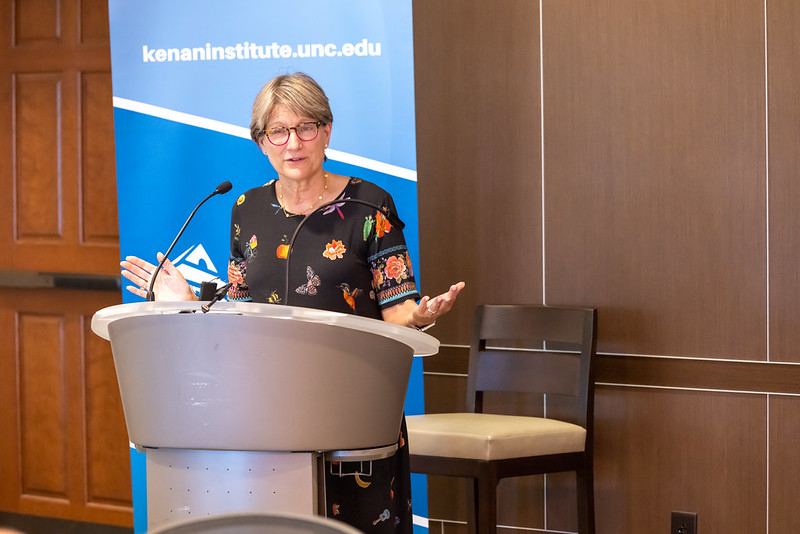
CREATE Faculty Director and UNC Public Policy Professor Maryann Feldman recently served as a panelist examining conditions for technology-based economic development. While speaking to the President’s Council of Advisors on Science and Technology Sept. 29, Feldman cautioned against treating universities as lynchpins in the effort to drive regional innovation—noting reforms are needed to help university technology transfer offices recoup operating costs—and strongly advocated for new financing models to spur economic development in areas lacking venture capital support.

As the pandemic forced shutdowns across the globe, U.S. government entities at the federal, state and local levels worked swiftly to secure known drivers of economic growth and job creation – including entrepreneurial ecosystems and small businesses. And while the programs implemented were widely lauded as successful, the story of who benefitted – and who did not – is more complex. This week’s Kenan Insight explores our experts’ key findings around the roles of policy and implementation in supporting equal access to opportunity.

The COVID-19 pandemic increased economic inequities in a number of ways, including in access to external capital – and while 2020 marked a break-out year for venture-backed firms, the pandemic hit many main street businesses hard. In this Kenan Insight, we explore the forces driving the haves and have-nots in this new economic climate, as well as actionable policy solutions as government support programs wind down.

VC University LIVE is a three-day certificate program on venture finance, created by NVCA, Startup@BerkeleyLaw, and Venture Forward in 2019, and held in partnership with universities in emerging VC ecosystems across the country.

Join Strategic Advisor to the CEO of Ripple and former Co-President of Morgan Stanley Zoe Cruz as she discusses the impact of adding cryptocurrencies to a traditional portfolio.

Major strides have been taken in recent years to push toward more sustainable investing practices, yet it remains to be seen if such initiatives are actually meeting their goals. In this Kenan Insight, we look at the challenges of both implementing and measuring the effectiveness of social entrepreneurship and impact investing.

One of the long-standing damages of institutional racism in the United States has been a bleak economic outlook for African Americans. In this Kenan Insight, we ask whether today’s activism might prove to be a defining moment in turning the tide for Black economic futures, and if so, who will play the key roles in creating lasting change.

NVCA and Startup@BerkeleyLaw have selected SMU and the University of North Carolina at Chapel Hill to host VC University LIVE programs in 2020-21, spotlighting the local venture communities and convening local and coastal industry leaders.

Hosted by the North Carolina Investment Forum, this invitation-only breakfast will bring together members of the private capital community to launch efforts in compiling a comprehensive analysis of capital availability in North Carolina.

Small businesses are an undeniable engine of growth for the United States, comprising 99 percent of all U.S. firms and driving nearly half our total economic activity. Yet small business owners across the country lack sufficient capital to succeed, grow and scale. The Kenan Institute has conducted a new analysis on the role of the Small Business Administration’s SBIC program in providing capital to the often-overlooked small businesses operating outside of metropolitan centers, as well as those owned by women and underrepresented minorities. Greg Brown, executive director at the Kenan Institute and professor of finance at UNC Kenan-Flagler Business School, discusses the findings in this video.

Small businesses are an undeniable engine of growth for the United States, comprising 99 percent of all U.S. firms and driving nearly half our total economic activity. Yet small business owners across the country lack sufficient capital to succeed, grow and scale. The Kenan Institute has conducted a new analysis on the role of the Small Business Administration’s SBIC program in providing capital to the often-overlooked small businesses operating outside of metropolitan centers, as well as those owned by women and underrepresented minorities. You can access an overview of our findings, as well as key takeaways for business and policy leaders, by clicking below.
An inside look at the plenary sessions of the fourth annual Frontiers of Entrepreneurship conference, which convened practitioners, policymakers and academics to discuss the most challenging issues in the field of entrepreneurship and set the agenda for future research and policy.

China’s venture capital funding has contracted significantly since mid-2018. According to Christian Lundblad, director of research at the Kenan Institute, this is a byproduct of U.S. trade policy, some domestic Chinese investment policy and the usual ups and downs in a developing market.

China’s venture capital funding has contracted significantly since mid-2018. According to Christian Lundblad, director of research at the Kenan Institute, this is a byproduct of U.S. trade policy, some domestic Chinese investment policy and the usual ups and downs in a developing market. Some experts are now questioning if this will be China’s “tech bubble."

Venture capital has existed since the 1970s, expanding and becoming more institutionalized year after year. But its growth in the aftermath of the global financial crisis has been unprecedented.

Five individuals from the fields of economics and entrepreneurship will spend a year strengthening collaboration between the University of North Carolina at Chapel Hill and Duke University, contributing to the schools’ teaching missions, and providing at least one major public lecture or performance.

The Kenan Institute of Private Enterprise and Duke University have announced the selection of the 2020 Keohane Distinguished Visiting Professorship recipients.

Please join us for an exclusive conversation with Andreessen Horowitz Managing Partner Scott Kupor on Monday, Oct. 21 from 4–5 p.m. The event is part of the Dean’s Speaker Series, hosted by Kenan-Flagler Business School Dean Doug Shackelford.
The third annual Kenan Institute Frontiers of Entrepreneurship Conference convened thought leaders from academia, industry and government to debate the most challenging current issues in the field of entrepreneurship and set the agenda for future research and policy. It was held on Jan. 31 and Feb. 1, 2019 at The Breakers Palm Beach.